When sourcing baby diapers from China, one of the first questions importers ask is: What is the minimum order quantity?
Understanding baby diaper MOQ is essential for distributors, wholesalers and entrepreneurs planning to launch or expand a diaper business. Minimum order quantities influence purchasing budgets, product selection, packaging, customization, inventory management and shipping costs.
However, not all baby diaper suppliers have the same MOQ requirements. The minimum quantity may vary significantly depending on whether you are purchasing an existing brand, ordering standard products or developing your own private label baby diapers.
In this guide, we explain how baby diaper MOQ works, what factors affect minimum order quantities and how importers can plan their orders more effectively.
Table of Contents
- What Does MOQ Mean in the Baby Diaper Industry?
- Why Do Baby Diaper Manufacturers Have MOQ Requirements?
- Ready-Stock Baby Diapers vs. OEM Baby Diapers
- What Factors Affect Baby Diaper MOQ?
- Does MOQ Apply to Each Diaper Size or the Total Order?
- How Customized Packaging Affects MOQ
- How MOQ Affects Container Loading and Shipping Costs
- How to Calculate Your Initial Diaper Order Quantity
- How to Negotiate Baby Diaper MOQ with Manufacturers
- Common Mistakes Importers Make About MOQ
- A Smarter Approach for New Baby Diaper Importers
- How to Choose a Baby Diaper Manufacturer with Suitable MOQ
- Cuddledry: Flexible Options for Different Types of Buyers
- What Information Should You Send When Requesting a Diaper MOQ Quotation?
- Frequently Asked Questions About Baby Diaper MOQ
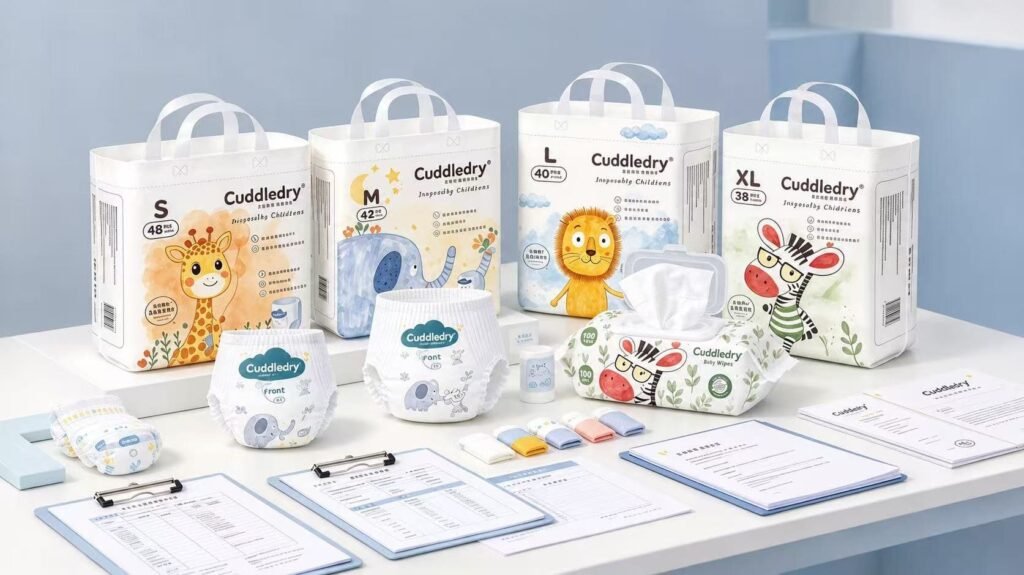
1. What Does MOQ Mean in the Baby Diaper Industry?
MOQ stands for Minimum Order Quantity. It is the smallest quantity of a product that a supplier is willing to sell or manufacture under specific conditions.
In the baby diaper industry, MOQ may be calculated in several different ways:
-
- Number of individual diapers
- Number of retail packs
- Number of cartons
- Quantity per diaper size
- Quantity per packaging design
- Quantity per product specification
- Full-container loading requirements
For example, a supplier may offer a low MOQ for ready-stock diapers but require a much larger order for products with customized packaging and printed backsheets.
This is why buyers should never assume that a manufacturer’s advertised MOQ applies to every product or customization option.
2. Why Do Baby Diaper Manufacturers Have MOQ Requirements?
Baby diapers are manufactured using automated production equipment designed for continuous, high-volume output. Unlike handmade products, diapers require coordinated material feeding, cutting, bonding, elastic application, inspection and packaging processes. Each production run involves preparation, machine adjustments, material handling and quality-control procedures.
Production Line Efficiency
Modern diaper production lines operate most efficiently when producing consistent specifications over longer production runs. Changing between sizes or product designs may require machine adjustments and additional setup time. Very small customized orders can therefore increase production costs per diaper.
Raw Material Purchasing
Baby diapers contain multiple components, including nonwoven materials, absorbent polymers, fluff pulp, elastic materials and packaging films. Manufacturers often purchase these materials in industrial quantities. Some customized materials may have their own minimum purchasing requirements.
Packaging Production
Custom packaging frequently involves printing preparation, artwork approval and minimum film production quantities. Even when the diaper itself uses a standard specification, customized packaging can increase the MOQ.
Quality Control and Production Planning
Each production batch requires inspection and coordination. Manufacturers must balance production efficiency with consistent product quality and delivery schedules. For these reasons, MOQ is not simply a sales policy. It is often connected to the practical economics of manufacturing.
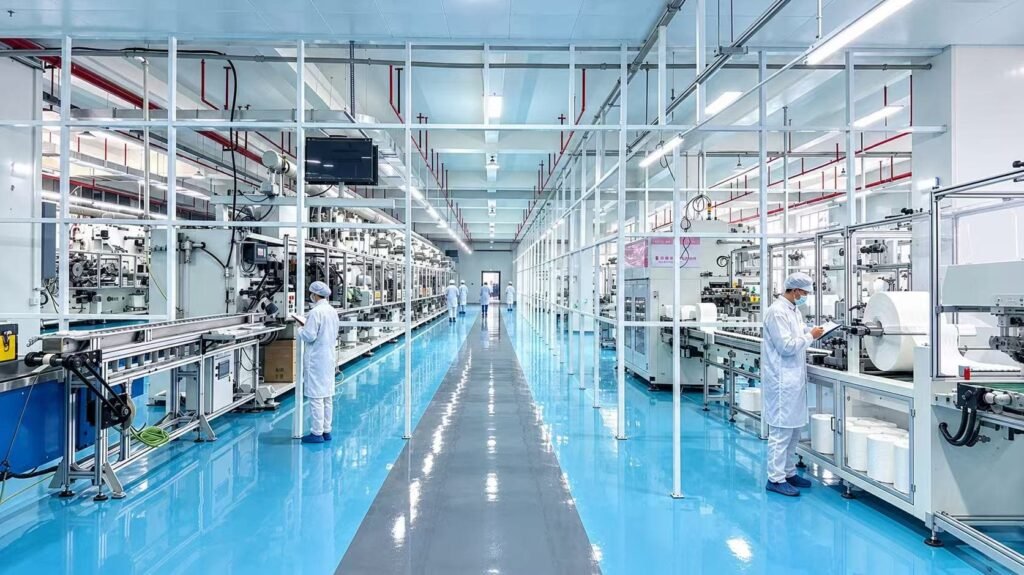
3. Ready-Stock Baby Diapers vs. OEM Baby Diapers: Why MOQ Is Different
Understanding the differences in baby diaper MOQ between ready-stock products and OEM manufacturing can help importers choose a suitable purchasing strategy.
Ready-Stock Baby Diapers
Ready-stock products are manufactured under an existing brand and packaging design. Because the products are already developed, buyers generally do not need to invest in customized printing or packaging preparation. Depending on available inventory, suppliers may accept smaller orders. Ready-stock diapers can be suitable for:
- New distributors testing market demand
- Small wholesalers
- Online retailers
- Local baby product shops
- Businesses exploring a new market
OEM and Private Label Baby Diapers
OEM and private label manufacturing involves producing diapers under the buyer’s own brand. Customization may include packaging artwork, diaper printing, material specifications and other product features. These requirements often create additional production and material purchasing minimums.
As a result, private label baby diaper MOQ is usually higher than ready-stock MOQ, although the exact quantity depends on the manufacturer and project.
For importers with limited starting capital, it may be more practical to begin with an existing brand before investing in fully customized production.
4. What Factors Affect Baby Diaper MOQ?
Several factors determine the minimum order quantity for a baby diaper project.
Diaper Type
Baby tape diapers and baby diaper pants use different product structures and production processes. MOQ requirements may vary between these two categories.
Diaper Size
Different sizes may require separate production runs or adjustments. Manufacturers may therefore set minimum quantities for individual sizes.
Product Specification
Standard specifications are often easier to produce in smaller quantities than highly customized products. Special absorbent cores, materials or construction requirements may affect production feasibility.
Customized Backsheet Printing
Printing a buyer’s logo or artwork directly on the diaper may involve additional printing preparation and material minimums.
Packaging Design
Customized packaging is one of the most common factors affecting MOQ. Different artwork for each diaper size may create separate printing requirements.
Order Frequency
For established customers with regular purchasing schedules, manufacturers may be able to discuss more efficient production arrangements. However, any flexibility depends on the supplier’s actual capabilities and commercial agreement.
5. Does MOQ Apply to Each Diaper Size or the Total Order?
This is one of the most important questions buyers should ask before placing an order. Some manufacturers calculate MOQ per diaper size, while others may consider the total order quantity.
For example, imagine an importer wants to order five sizes:
- Small (S)
- Medium (M)
- Large (L)
- Extra Large (XL)
- Extra Extra Large (XXL)
The buyer may assume that ordering a sufficient total quantity will satisfy the factory’s MOQ. However, the manufacturer may require a minimum quantity for each individual size. This difference can significantly affect the buyer’s purchasing budget.
Before confirming an order, ask the manufacturer:
- Is MOQ calculated per size or per total order?
- Can different sizes be combined?
- Can tape diapers and diaper pants be combined?
- Does each packaging design have a separate MOQ?
- Are there different requirements for first orders and repeat orders?
Getting clear answers early can prevent misunderstandings during order confirmation.
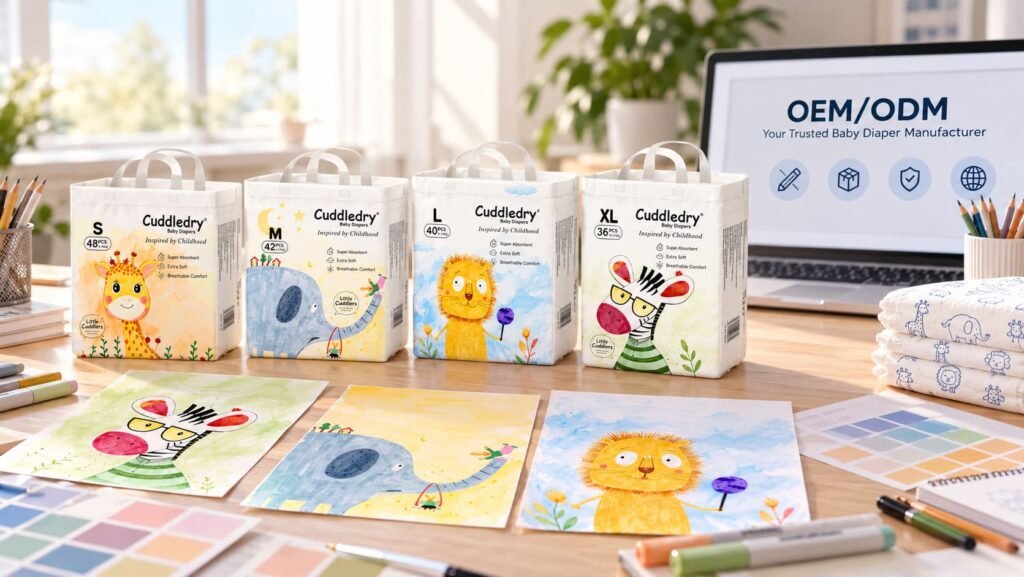
6. How Customized Packaging Affects MOQ
Packaging is an essential part of private label baby diaper development. For many new brands, attractive packaging helps communicate product positioning and differentiate the product from competitors. However, packaging customization can also increase the minimum order quantity. When planning customized packaging, importers should confirm how printing requirements affect the baby diaper MOQ for each size and packaging design.
Printing Preparation
Custom packaging may require printing cylinders, plates or other production preparation, depending on the printing process. These costs should be discussed before final artwork approval.
Minimum Packaging Film Quantity
Packaging suppliers may require a minimum quantity of printed film for each design. If a buyer develops separate packaging artwork for multiple sizes, each design may have its own minimum.
Packaging Dimensions
Different diaper sizes and pack quantities may require different bag dimensions. This can influence material consumption and packaging production planning.
Reducing Packaging Complexity
Importers can sometimes simplify their initial product range by using consistent packaging structures and limiting unnecessary variations. However, combining designs or dimensions does not automatically eliminate printing MOQs. Always confirm the packaging manufacturer’s actual requirements.
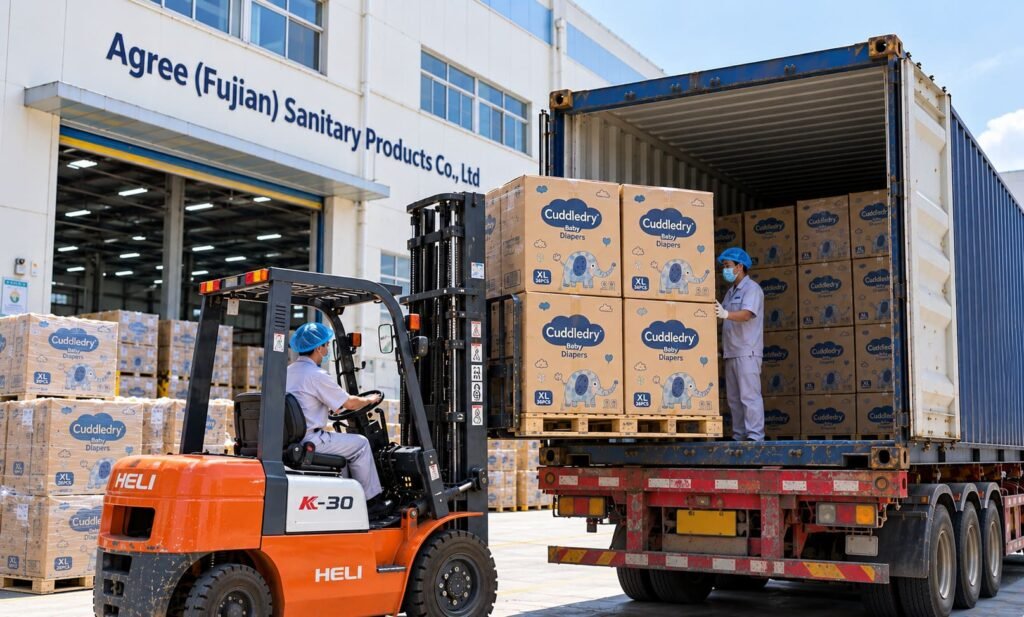
7. How MOQ Affects Container Loading and Shipping Costs
MOQ and container loading are closely connected, but they are not the same thing. MOQ determines the minimum quantity required by the supplier. Container loading determines how many products can fit into a shipping container. Baby diapers are relatively lightweight but occupy considerable space. For many diaper shipments, container volume is a major limitation.
20-Foot Containers
A 20-foot container may be considered for certain shipment plans, depending on the product volume, packaging dimensions and logistics arrangements.
40-Foot High-Cube Containers
A 40HQ container offers greater internal volume and is commonly considered for high-volume shipments of bulky products such as diapers. However, the actual loading quantity depends on the dimensions of each pack, carton or bale.
Why Pack Quantity Matters
Two diaper products with the same number of pieces may have different shipping volumes because of packaging design and compression.
Importers should therefore request:
- Pieces per pack
- Packs per carton or bale
- Carton or bale dimensions
- Total shipment volume
- Estimated container loading quantity
This information helps buyers estimate freight costs per diaper and plan their selling prices more accurately.
8. How to Calculate Your Initial Diaper Order Quantity
Before negotiating MOQ, importers should estimate their actual market demand. Ordering too little may increase logistics costs per unit. Ordering too much may create unnecessary inventory pressure. A practical approach is to estimate expected sales over a defined period. A realistic sales forecast helps importers determine whether the supplier’s baby diaper MOQ matches their expected market demand.
Step 1: Estimate Monthly Sales
Consider how many retail outlets or distributors you expect to supply and how many packs each customer may purchase.
Step 2: Identify Your Best-Selling Sizes
Not all diaper sizes sell at the same rate. The preferred size mix depends on your target market, customer demographics and product positioning.
Step 3: Plan Your Inventory Coverage
Consider how much stock you need to cover sales during production and shipping lead times.
Step 4: Include Safety Stock
A reasonable safety-stock allowance can help protect against unexpected demand or shipping delays.
Step 5: Compare Demand with Supplier MOQ
If your estimated demand is significantly below the manufacturer’s MOQ, consider simplifying your product range or exploring ready-stock options.
The goal is to develop an order plan that is commercially realistic, not simply to purchase the largest possible quantity.
9. How to Negotiate Baby Diaper MOQ with Manufacturers
MOQ negotiation is often more productive when buyers explain their business plans clearly. Instead of asking only, “Can you reduce your MOQ?”, provide information that helps the manufacturer evaluate possible solutions.
Share Your Target Market
Explain where the products will be sold and which market segment you intend to serve.
Provide Your Expected Order Volume
Share a realistic estimate of your initial order and potential repeat orders.
Be Flexible with Product Specifications
Using an existing product structure may be more practical than requesting extensive customization for a small order.
Consider Standard Packaging
Standard or ready-stock packaging may help reduce complexity, depending on the supplier’s available products.
Discuss a Long-Term Purchasing Plan
A realistic repeat-order forecast may help the supplier plan production more efficiently. However, buyers should avoid promising volumes they cannot reasonably achieve. Successful MOQ negotiation should create a workable arrangement for both the buyer and manufacturer.
10. Common Mistakes Importers Make About MOQ
Understanding MOQ can help buyers avoid several common purchasing mistakes.
Confusing Ready-Stock MOQ with OEM MOQ
A supplier’s low advertised MOQ may apply only to existing branded products. Always confirm the minimum quantity for customized orders separately.
Ignoring MOQ per Size
A total order quantity may not satisfy individual size requirements.
Focusing Only on Unit Price
A lower diaper price may be offset by higher shipping costs, unsuitable packaging or excessive inventory.
Developing Too Many Packaging Designs
Multiple packaging variations can increase printing requirements and inventory complexity.
Ordering Without Testing Samples
Always evaluate product quality and specifications before committing to bulk production.
Overestimating Initial Sales
Large orders may reduce certain unit costs, but unsold inventory ties up working capital. A sustainable purchasing plan should balance MOQ, product quality, logistics and actual market demand.
11. A Smarter Approach for New Baby Diaper Importers
For businesses entering the diaper market for the first time, a gradual approach may help reduce commercial risk.
Stage 1: Test Your Market
Start by understanding consumer preferences, popular diaper sizes, acceptable prices and local distribution channels.
Stage 2: Evaluate Product Quality
Request samples and compare softness, absorbency, fit and leakage protection.
Stage 3: Start with a Manageable Product Range
Focus on the products and sizes most relevant to your market rather than launching too many variations.
Stage 4: Build Repeat Sales
Collect customer feedback, monitor sales performance and improve your purchasing forecasts.
Stage 5: Consider Private Label Manufacturing
Once demand becomes more predictable, you can evaluate whether developing your own baby diaper brand is commercially appropriate.
For a broader overview of brand development, read our guide on how to start your own baby diaper brand.
12. How to Choose a Baby Diaper Manufacturer with Suitable MOQ
MOQ should be considered alongside manufacturing capability, quality consistency and export experience. A supplier offering a low MOQ is not necessarily the best partner if product quality or delivery reliability is inconsistent. Choosing a manufacturer with a suitable baby diaper MOQ is important, but consistent product quality, reliable delivery and long-term cooperation are equally essential.
When evaluating manufacturers, consider:
- Experience producing baby diapers
- Available product specifications
- Ready-stock and OEM options
- MOQ requirements for each size
- Packaging customization capabilities
- Quality-control procedures
- Production and delivery lead times
- International shipping experience
- Communication and after-sales support
For more detailed supplier evaluation advice, read our guide to choosing a reliable baby diaper manufacturer in China.
13. Cuddledry: Flexible Options for Different Types of Buyers
At Cuddledry, we understand that not every importer or distributor begins with the same purchasing volume.
Some customers want to test a new market with a relatively small order. Others are preparing to launch their own diaper brands with customized specifications and packaging.
These projects require different purchasing approaches.
Ready-to-Sell Cuddledry Products
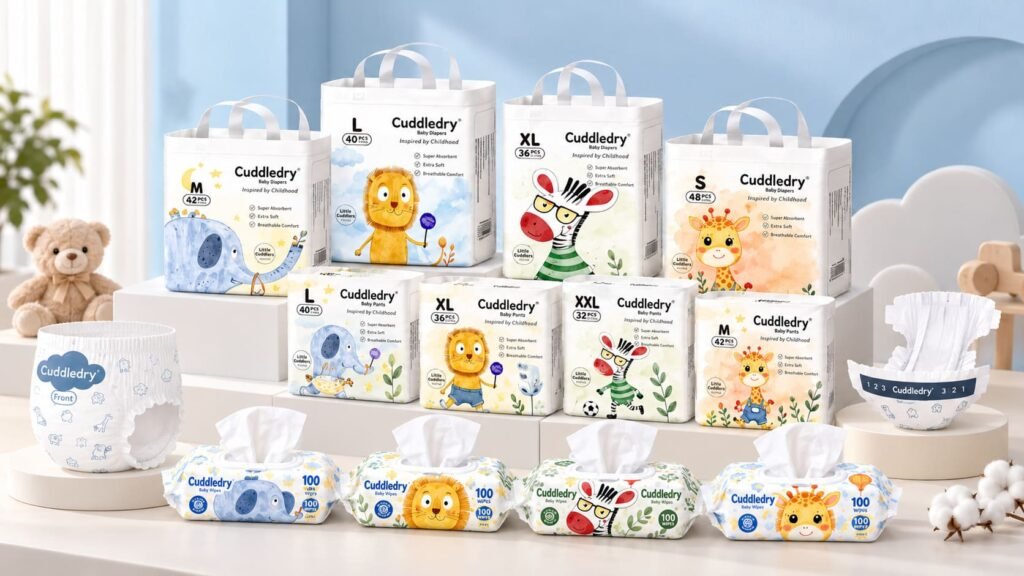
For buyers who want to begin with an established product range, Cuddledry offers branded baby diapers and diaper pants.
Our ready-stock approach is designed to support smaller distributors and businesses exploring new markets, subject to product and inventory availability.
OEM and Private Label Manufacturing
For customers developing their own brands, we can discuss OEM manufacturing options based on product specifications, packaging requirements and expected order quantities.
Customized production generally requires higher minimum quantities than ready-stock purchasing.
Our team can help buyers understand the differences and identify suitable options for their business stage.
Planning for Long-Term Growth
Whether you begin with Cuddledry products or develop your own brand, a successful diaper business depends on consistent quality, realistic purchasing plans and reliable supply.
We welcome discussions with importers, wholesalers, distributors and brand owners looking for long-term cooperation.
14. What Information Should You Send When Requesting a Diaper MOQ Quotation?
To receive a useful quotation, provide as much relevant information as possible.
- Destination country: Where will the diapers be imported?
- Product type: Baby tape diapers or diaper pants?
- Brand preference: Cuddledry ready-stock products or your own private label?
- Required sizes: Which diaper sizes do you need?
- Expected quantity: How many packs or containers are you planning to order?
- Product positioning: Economy, mid-range or premium?
- Packaging requirements: Standard packaging or customized artwork?
- Target price: What price range are you aiming for?
- Shipping requirements: Preferred destination port and trade terms?
Providing these details helps the manufacturer recommend appropriate products and clarify the applicable MOQ.
Frequently Asked Questions About Baby Diaper MOQ
What is the MOQ for baby diapers from China?
There is no universal baby diaper MOQ. Minimum quantities vary by supplier, product type, packaging, size and customization requirements. Ready-stock products may have lower MOQs than customized OEM production.
Can I order baby diapers in small quantities?
Some suppliers offer smaller quantities for ready-stock branded products. Customized private label production generally has different minimum requirements.
Is MOQ calculated per diaper size?
It depends on the supplier. Some manufacturers require a minimum quantity for each size, while others may allow certain combinations. Confirm the exact conditions before placing an order.
Why does private label baby diaper MOQ tend to be higher?
Private label manufacturing may require customized packaging, printing preparation, material purchasing and dedicated production arrangements.
Can I mix different diaper sizes in one container?
Mixed-size shipments may be possible, but each size must still satisfy any applicable production or packaging MOQ. Confirm the size mix and loading plan with your supplier.
Does ordering a full container reduce the MOQ?
A full container may improve shipping efficiency, but it does not automatically eliminate minimum production quantities for individual sizes or customized materials.
Can I negotiate MOQ with a baby diaper manufacturer?
MOQ flexibility depends on the manufacturer’s production arrangements and the project requirements. Buyers may have more options when they use standard specifications, simplify packaging or provide realistic repeat-order plans.
Should I choose the supplier with the lowest MOQ?
Not necessarily. Product quality, unit cost, logistics, production reliability and long-term supply capability are also important considerations.
Start Your Baby Diaper Sourcing Project with Cuddledry
Understanding baby diaper MOQ is an important step toward building a sustainable importing or distribution business.
Whether you are looking for ready-to-sell Cuddledry products or exploring OEM manufacturing for your own brand, our team can help you discuss product specifications, packaging options and order requirements.
Tell us about your target market, preferred diaper products and expected order quantity. We will help you explore suitable purchasing options.