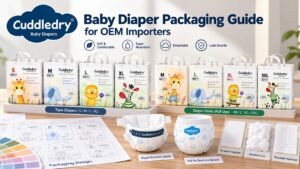
Finding a baby diaper manufacturer in China is easy. Finding the right manufacturer for your market is much more difficult.
If you search online, you will find hundreds of diaper suppliers offering different prices, specifications, materials and packaging options. At first glance, many of the products may even look very similar. But after years of working in the hygiene products industry, we have learned one important lesson:
Two diapers that look almost identical can perform very differently in actual use.
For importers, distributors and private-label brand owners, choosing the right manufacturer is therefore about much more than finding the lowest price. You need to consider product quality, raw materials, absorbency, comfort, manufacturing consistency, OEM capability, MOQ, packaging, quality control and export experience. Here are the most important things to look for when choosing a baby diaper manufacturer in China.
1. Start With Your Market, Not With the Diaper
One of the first questions buyers often ask us is: “What is your best diaper?”
But there is no single diaper specification that is best for every market. A premium diaper designed for pharmacies or online consumers may not be suitable for a price-sensitive wholesale market. Likewise, an economy diaper designed for mass distribution may not meet the expectations of consumers looking for an ultra-soft premium product. Before asking a manufacturer for a quotation, first define your market. Consider:
- Target country
- Target consumers
- Retail price range
- Economy, mid-range or premium positioning
- Main sales channel
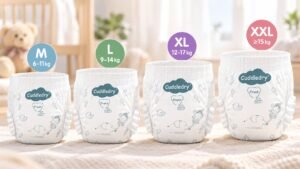
- Required diaper sizes
- Tape diaper or pull-up pants
- Pack quantity
- Absorbency expectations
- Softness requirements
- Packaging style
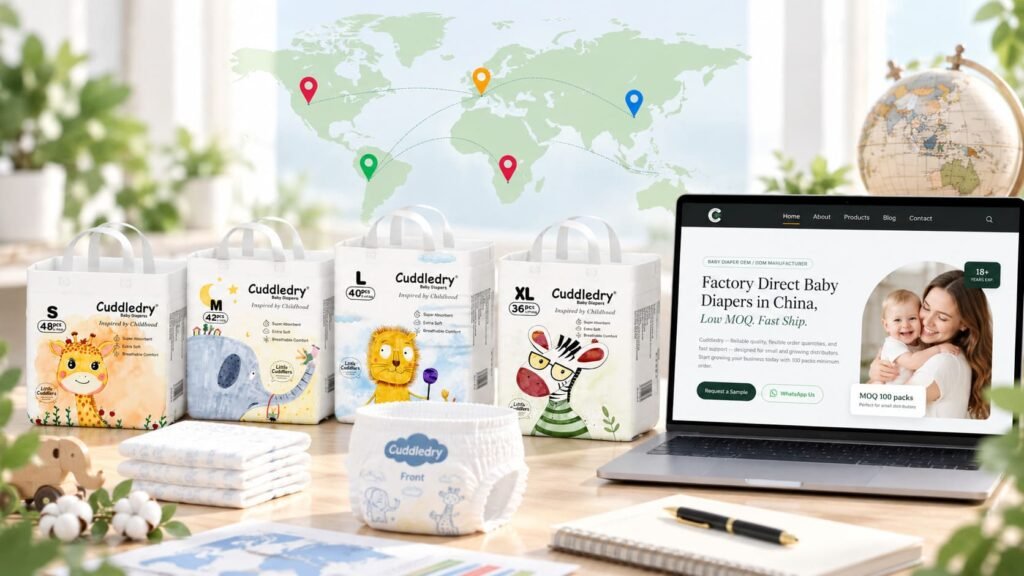
For example, a supermarket distributor may focus heavily on competitive pricing, pack count and shelf presentation. A premium online brand may care more about softness, thinness, breathable materials, packaging design and product differentiation. A good diaper manufacturer should understand these differences and recommend a product specification according to your market instead of simply offering the same diaper to every customer.
2. Understand What Is Inside a Baby Diaper
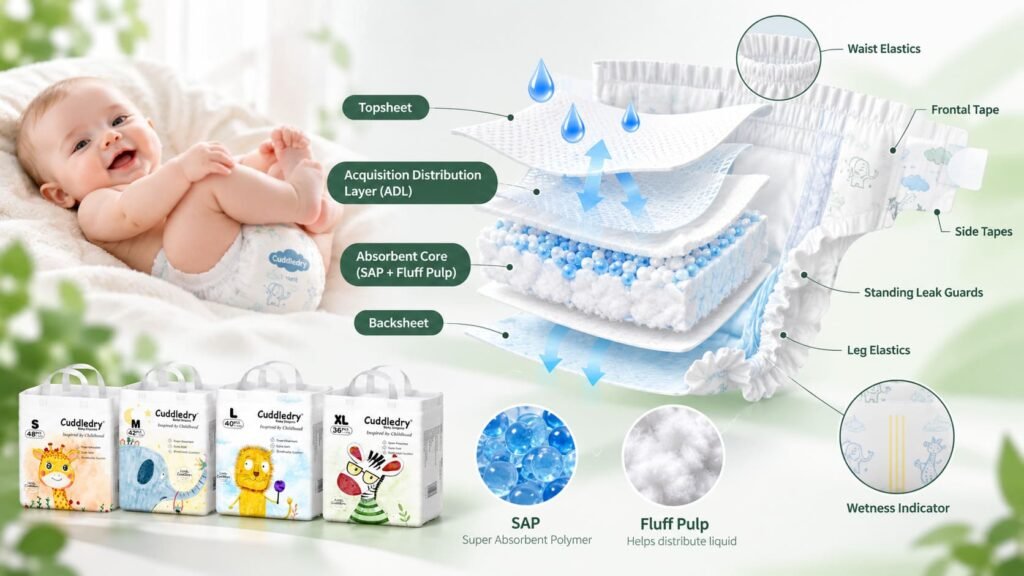
A diaper is much more than a soft outer surface. A typical disposable baby diaper contains several functional layers and components, including: Topsheet → Acquisition Distribution Layer (ADL) → Absorbent Core → Backsheet. It also contains components such as:
- SAP
- Fluff pulp
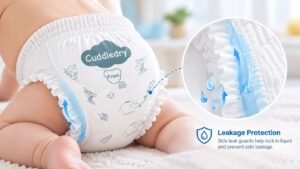
- Standing leak guards
- Leg elastics
- Waist elastics
- Frontal tape
- Side tapes
- Hot-melt adhesive
- Wetness indicator
Each component affects the final performance and cost of the diaper.
SAP:
SAP stands for Super Absorbent Polymer. It is one of the key materials responsible for absorbing and retaining liquid inside the diaper. However, more SAP does not automatically mean a better diaper. The quality of the SAP, its distribution inside the core and the overall core design also affect diaper performance.
Fluff Pulp:
Fluff pulp helps distribute liquid through the absorbent core. The combination of SAP, fluff pulp and other core materials can influence:
- Absorption speed
- Liquid distribution
- Liquid retention
- Diaper thickness
- Rewet performance
- Flexibility
- Overall cost
This is why comparing diapers only by weight can be misleading.
A heavier diaper is not necessarily a better diaper.
3. Don’t Look Only at Total Absorption
Another common question from buyers is: “How many milliliters can this diaper absorb?” Total absorption capacity is important, but it does not tell the whole story. Imagine a diaper that can hold a large amount of liquid but absorbs too slowly. When the baby urinates, liquid may remain temporarily on the surface before entering the absorbent core. This can increase the risk of leakage and make the surface feel wet. When evaluating a diaper, consider several performance factors together.
Absorption Speed
How quickly does liquid pass through the topsheet and enter the absorbent core?
Liquid Distribution
Does the liquid remain concentrated in one area, or does it spread effectively through the core?
Rewet
After the diaper absorbs liquid, how much moisture returns to the surface when pressure is applied? Lower rewet generally helps the surface remain drier against the baby’s skin.
Retention
Can the absorbent core retain liquid effectively after absorption?
Leakage Protection
The absorbent core works together with the leg elastics, standing leak guards and overall diaper fit to help prevent leakage. A good diaper should therefore be evaluated as a complete system rather than by a single absorption number.
4. Always Request Samples Before Placing a Bulk Order
Never approve a new baby diaper based only on photos, specifications or videos. Request physical samples and test them yourself.
When samples arrive, compare several products side by side.
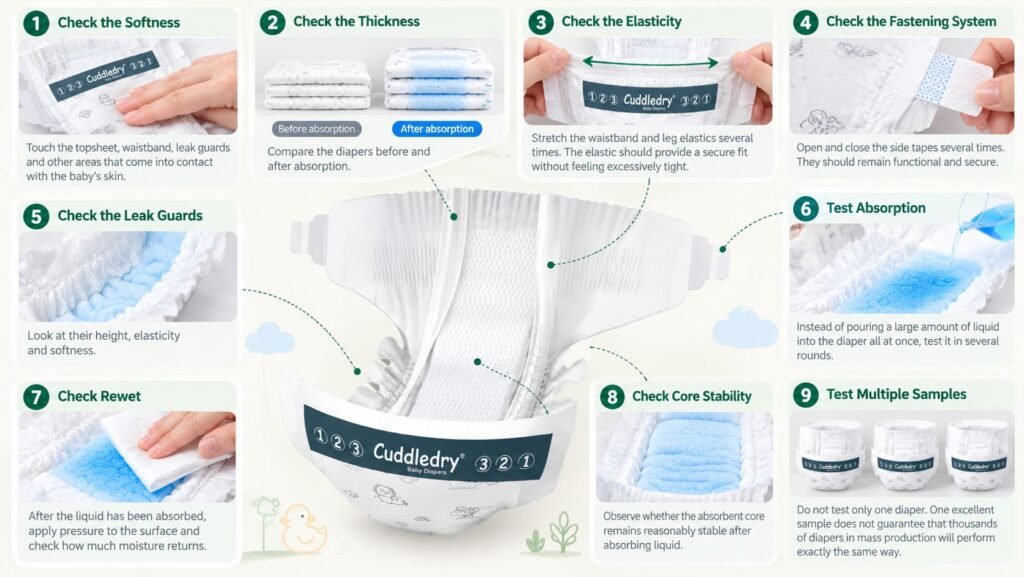
Check the Softness
Touch the topsheet, waistband, leak guards and other areas that come into contact with the baby’s skin.
Check the Thickness
Compare the diapers before and after absorption.
Check the Elasticity
Stretch the waistband and leg elastics several times. The elastic should provide a secure fit without feeling excessively tight.
Check the Fastening System
Open and close the side tapes several times. They should remain functional and secure.
Check the Leak Guards
Look at their height, elasticity and softness.
Test Absorption
Instead of pouring a large amount of liquid into the diaper all at once, test it in several rounds. This better simulates repeated urination.
Check Rewet
After the liquid has been absorbed, apply pressure to the surface and check how much moisture returns.
Check Core Stability
Observe whether the absorbent core remains reasonably stable after absorbing liquid. Most importantly, do not test only one diaper.
One excellent sample does not guarantee that thousands of diapers in mass production will perform exactly the same way. For a successful diaper brand, consistency matters.
5. Ask About Raw Material Options
A professional baby diaper manufacturer should be able to explain the materials used in the product. Ask your supplier about:
- Topsheet
- SAP
- Fluff pulp
- ADL
- Backsheet
- Leak guards
- Waist elastic
- Leg elastic
- Frontal tape
- Side tape
- Hot-melt adhesive
- Wetness indicator
You do not necessarily need the most expensive material for every component. The objective is to create the right combination of performance and cost for your target market. For example, if you are developing a premium baby diaper, you may place more emphasis on:
- Ultra-soft topsheet
- Breathability
- Thin absorbent core
- Fast acquisition
- Low rewet
- Flexible waistband
- Premium packaging
If you are developing an economy diaper, the challenge is different. You need to control the product cost while maintaining the essential performance consumers expect. This is where an experienced diaper manufacturer can provide real value. A supplier should not simply ask: “What price do you want?” They should also be able to explain:
“If we change the price, what will change in the product?”
6. Make Sure You Are Comparing the Same Specification
Suppose Manufacturer A quotes: USD 0.085 per piece
and Manufacturer B quotes: USD 0.075 per piece
Manufacturer B appears cheaper. But are you actually comparing the same diaper? Before comparing prices, check:
- Product dimensions
- Product weight
- SAP specification and quantity
- Fluff pulp
- Topsheet material
- ADL
- Backsheet
- Waistband
- Leak guard construction
- Elastic materials
- Tape system
- Wetness indicator
- Packaging
- Pieces per bag
- Bags per carton
- Quantity per container
A lower quotation may simply represent a lower or different specification. This leads to one of the most important rules in diaper sourcing: Compare the specification first. Compare the price second. This simple principle can prevent many sourcing mistakes.
7. Evaluate the Manufacturer’s OEM and Private-Label Capability
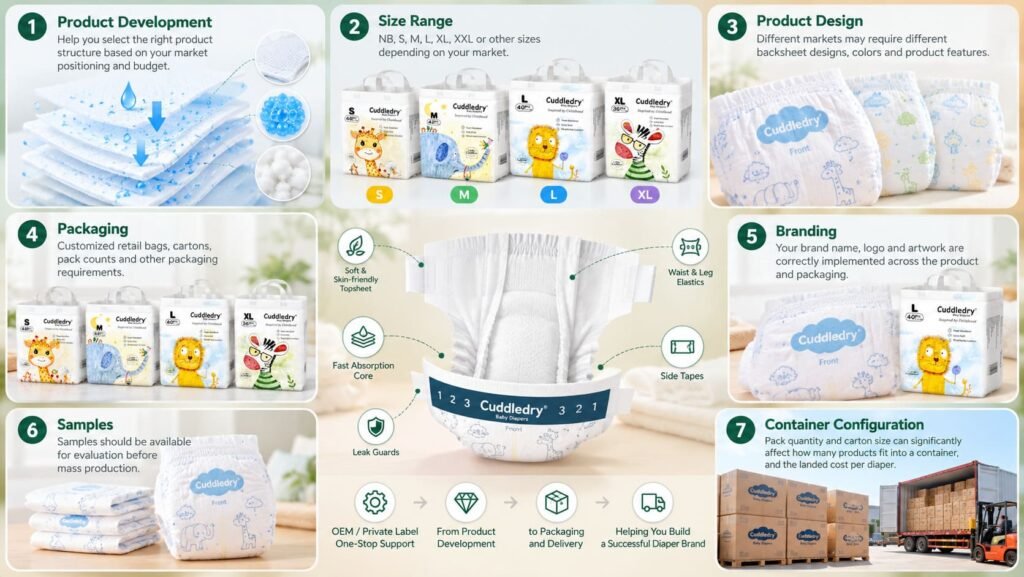
If you are building your own diaper brand, manufacturing the diaper itself is only part of the project. A good OEM or private-label diaper manufacturer should also be able to support you with several other areas.
Product Development
The manufacturer should help you select an appropriate product structure based on your market positioning and budget.
Size Range
Depending on your market, you may need NB, S, M, L, XL, XXL or other sizes.
Product Design
Different markets may require different backsheet designs, colors and product features.
Packaging
The manufacturer should be able to discuss customized retail bags, cartons, pack counts and other packaging requirements.
Branding
Your brand name, logo and artwork need to be correctly implemented across the product and packaging.
Samples
Samples should be available for evaluation before mass production.
Container Configuration
Pack quantity and carton size can significantly affect how many products fit into a container. For importers, this directly affects the landed cost per diaper. A strong OEM partner should therefore think beyond production and help you develop a commercially workable product.
8. Understand the MOQ Before Finalizing Your Packaging
MOQ — Minimum Order Quantity — is especially important for new diaper brands. For example, you may initially want:
- Five diaper sizes
- Two packaging designs
- Several pack quantities
From a marketing perspective, this sounds attractive. From a manufacturing perspective, however, it can create many individual SKUs. Each SKU may require different:
- Packaging bags
- Cartons
- Printing
- Production setup
- Raw-material planning
- Inventory management
This is why we recommend discussing MOQ with your manufacturer before finalizing all packaging artwork. Ask questions such as:
- What is the MOQ per size?
- Can different sizes be combined?
- Is the MOQ calculated by pieces, bags or production runs?
- Does customized packaging have a separate MOQ?
- Can I start with fewer sizes?
- Which sizes normally sell fastest in my target market?
- What is the most economical combination for the first container?
For a new brand, launching the right products is often more important than launching too many products.
9. Ask About Quality Control During Mass Production
A perfect sample means very little if mass production is inconsistent. Before selecting a manufacturer, understand how quality is controlled throughout production.
Incoming Raw Material Inspection
Materials such as SAP, fluff pulp, nonwoven fabric, films, elastics and adhesives should be checked before production.
In-Process Quality Control
During manufacturing, the factory should monitor important production parameters and product construction.
Finished Product Inspection
Finished diapers should be checked according to the factory’s quality-control procedures. Depending on the product and testing system, evaluation may include:
- Product dimensions
- Product weight
- Absorption
- Absorption speed
- Rewet
- Retention
- Elastic performance
- Tape performance
- Appearance
- Packaging
Batch Traceability
If a problem occurs after shipment, the factory should be able to trace the relevant production information and investigate the cause. As your diaper business grows, production consistency becomes increasingly important. Consumers expect the diaper they purchase today to perform like the diaper they purchased last month.
10. Check the Manufacturer’s Export Experience
Manufacturing a diaper and exporting a diaper are two different skills. An experienced export supplier should understand issues such as:
- Export packaging
- Shipping marks
- Container loading
- Commercial invoices
- Packing lists
- Third-party inspections
- Customer-specific labeling
- Destination-market documentation
- Product registration requirements where applicable
Requirements differ from country to country. A product exported to Africa may have different commercial or regulatory requirements from one exported to Europe, the Middle East, Asia or Latin America. Always confirm the specific requirements of your destination market before mass production.
11. Visit the Factory If Possible
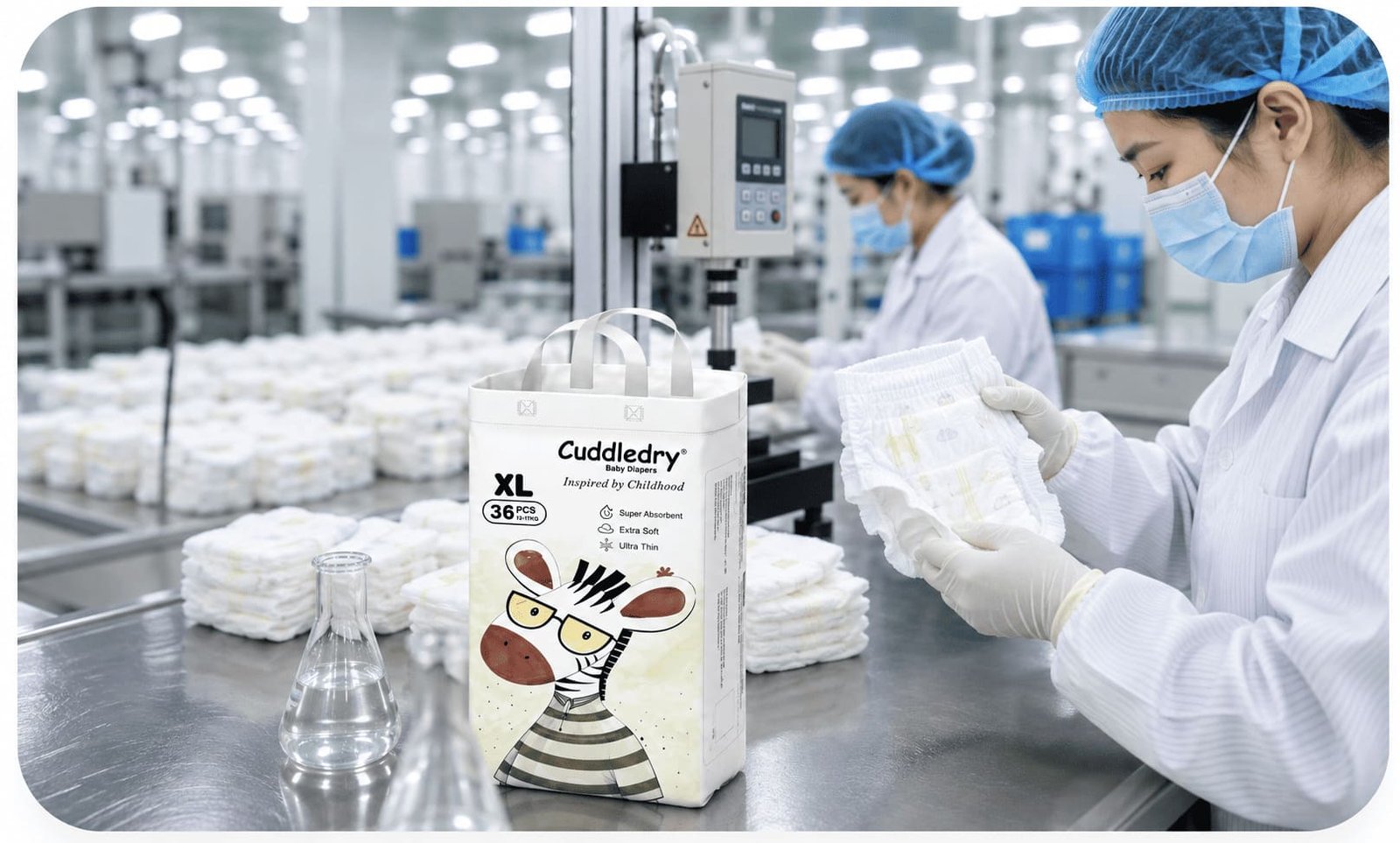
If you are planning a significant or long-term diaper business, visiting the factory can be extremely valuable. But when you visit, do not spend the entire day in the meeting room. Ask to see the complete production process:
Raw Material Warehouse → Production Line → Quality Control → Packaging → Finished Goods Warehouse
Pay attention to:
- Factory organization
- Production environment
- Production lines
- Machines in operation
- Quality-control procedures
- Raw-material storage
- Finished-product storage
- Packaging operations
- Staff knowledge
- Actual products being manufactured
A factory visit gives you information that cannot be obtained from a quotation sheet. It also gives both sides an opportunity to discuss product development face to face.

12. Don’t Choose a Diaper Supplier Only Because They Are the Cheapest
Price matters. We understand that very well. In many markets, even a difference of a fraction of a cent per diaper can become significant when purchasing millions of pieces. However, choosing the cheapest product without understanding the specification can create much larger costs later. These may include:
- Consumer complaints
- Leakage problems
- Poor repeat purchases
- Inconsistent product quality
- Packaging problems
- Delivery delays
- Unsold inventory
- Damage to your brand reputation
The question should therefore not simply be:
“Who can give me the cheapest diaper?”
A better question is:
“Which diaper gives my market the right balance of quality, price and profitability?”
That is the foundation of a sustainable diaper business.
Baby Diaper Manufacturer Checklist
Before placing your first bulk order, use this simple checklist:
| What to Check | Questions to Ask |
|---|---|
| Manufacturing | Are you the manufacturer? Where is production located? |
| Experience | How long have you produced baby diapers? |
| Products | Do you manufacture tape diapers and pull-up pants? |
| Raw Materials | What SAP, pulp, nonwoven and other materials are available? |
| Performance | How do you test absorption, rewet and leakage performance? |
| Samples | Can I test samples before ordering? |
| OEM | Can you customize the product and packaging? |
| MOQ | What is the MOQ per size and design? |
| Quality Control | How is mass-production quality controlled? |
| Consistency | How do you maintain batch-to-batch consistency? |
| Export | Which international markets do you currently serve? |
| Documentation | What export documents can you provide? |
| Container Loading | How many bags/cartons fit into a 40HQ? |
| Communication | Can your team explain technical specifications clearly? |
| Price | Am I comparing products with the same specification? |
Looking for a Baby Diaper Manufacturer in China?
At CuddleDry, we believe a successful diaper project starts with understanding your market — not simply sending you a price list. Different countries, distribution channels and consumer groups require different diaper specifications.
Our goal is to help importers, distributors, wholesalers and private-label brands find the right balance between quality, performance, price and market positioning.
CuddleDry can support customers looking for:
- Baby tape diapers
- Baby pull-up pants
- Wholesale baby diapers
- OEM baby diapers
- Private-label baby diapers
- Customized packaging
- New diaper brand development
If you are developing a new baby diaper brand or looking for a new supplier, tell us: Your country + required sizes + estimated quantity + target market + preferred quality level. Our team can recommend a suitable product specification and prepare samples for your evaluation.
Start Your Baby Diaper Project with CuddleDry
Looking for a reliable baby diaper manufacturing partner in China? Contact CuddleDry today to request samples, specifications and an OEM quotation. CuddleDry — Comfort for Babies. Confidence for Your Business.
Frequently Asked Questions
How do I find a reliable baby diaper manufacturer in China?
Evaluate the manufacturer’s production capability, raw materials, quality-control system, OEM experience, export experience and physical samples. Avoid choosing a supplier based only on the lowest quotation.
Can I create my own baby diaper brand in China?
Yes. OEM and private-label manufacturers can help produce diapers under your own brand. Depending on the project, customization may include packaging, logo, backsheet printing, product specifications, sizes and other features.
What is the MOQ for private-label baby diapers?
MOQ depends on the manufacturer, diaper specification, size, packaging and level of customization. Always confirm whether the MOQ applies per size, per design or to the entire order.
Should I request diaper samples before placing an order?
Yes. Samples allow you to evaluate softness, construction, absorption speed, rewet, elasticity, fastening and overall product quality before committing to bulk production.
What should I send a diaper manufacturer to get a quotation?
For a more accurate quotation, provide your target country, required sizes, estimated order quantity, preferred quality level, pack quantity, packaging requirements and whether you need OEM/private-label service.
Is the cheapest baby diaper always the best choice for distributors?
No. The lowest unit price may come from a different product specification. Importers should compare materials, product weight, absorbent core, performance, packaging and container quantity before comparing prices.