Baby diaper packaging plays an important role in product protection, brand positioning, retail presentation and international shipping. For importers, distributors and private label brand owners, choosing the right packaging is an essential part of developing a competitive diaper product.
Two baby diapers may have similar product specifications, but different packaging designs can create very different impressions on retail shelves. Packaging materials, pack quantities, printing quality and carton dimensions can also influence manufacturing costs and order planning.
For OEM buyers, packaging development involves more than adding a logo to a plastic bag. It requires coordination between product specifications, artwork design, printing requirements, labeling information and production quantities.
In this guide, we explain the most important baby diaper packaging options, how packaging affects MOQ and costs, and seven practical tips for developing packaging for wholesale and private label orders.
Table of Contents
- Why Baby Diaper Packaging Matters
- Common Baby Diaper Packaging Materials
- Recyclable and Biodegradable Packaging
- Choosing the Right Pack Size
- OEM Packaging Design and Branding
- Printing Methods and Packaging Colors
- What Are Packaging Plate Fees?
- Barcodes and Labeling Requirements
- How Packaging Affects MOQ
- Packaging Costs and Quotations
- Carton Packaging and Container Loading
- Seven Essential OEM Packaging Tips
- Common Packaging Mistakes
- Packaging Quality Control
- How Cuddledry Supports OEM Buyers
- Frequently Asked Questions
1. Why Baby Diaper Packaging Matters for Importers
Packaging is one of the first things customers notice when choosing baby diapers in a supermarket, pharmacy or online store.
For new brands, attractive and informative packaging can help communicate product positioning and make the product easier to identify.
However, good packaging must also serve practical functions.
Product Protection
Packaging helps protect diapers from dust, dirt and unwanted exposure during handling, storage and transportation.
The appropriate barrier properties depend on the packaging material and construction.
Brand Recognition
Colors, logos, illustrations and typography help customers recognize a brand.
Consistent design across different diaper sizes can make a product range easier to understand.
Product Information
Packaging communicates important details such as diaper size, pack quantity, product type and usage information.
Retail Presentation
Packaging dimensions, shape and printing quality can influence how products appear on retail shelves.
Wholesale and Logistics Efficiency
Packaging dimensions also affect carton quantities, warehouse storage and container loading.
For importers, successful packaging development requires balancing appearance, functionality, cost and logistics.
2. Common Baby Diaper Packaging Materials
Different baby diaper packaging materials offer different characteristics, costs and manufacturing requirements.
The most suitable material depends on the product positioning, packaging equipment and target market.
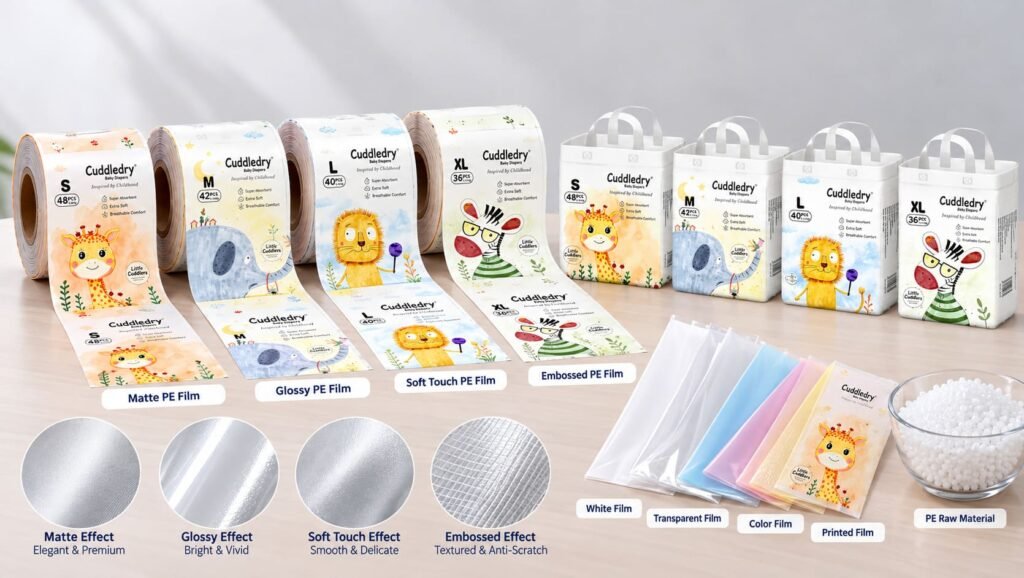
Polyethylene (PE) Packaging
Polyethylene-based plastic film is commonly used for flexible packaging applications.
Depending on the formulation and construction, PE packaging can provide flexibility, heat-sealing performance and suitable protection for disposable diaper products.
PE packaging may be suitable for economy, mid-range and premium products, depending on the film specification and printing quality.
Laminated Plastic Packaging
Some packaging structures combine different plastic layers to achieve particular mechanical, printing or barrier properties.
For example, laminated films may be selected to provide a desired surface finish, strength or packaging-machine compatibility.
However, multilayer packaging can introduce additional material costs and recycling challenges.
Matte and Glossy Finishes
Packaging appearance can also be influenced by surface finishing.
Glossy packaging may provide a bright appearance, while matte packaging can create a softer visual effect.
Neither finish automatically indicates better material quality.
What Should Importers Ask?
- What packaging material is proposed?
- What is the film thickness?
- Is the material compatible with the packing equipment?
- What printing options are available?
- What sealing method will be used?
- Can physical packaging samples be provided?
Before approving a packaging material, buyers should evaluate its suitability for the intended product and distribution conditions.
3. Recyclable, Biodegradable and Alternative Packaging Materials
Environmental considerations are becoming part of packaging discussions in many markets.
Some importers are interested in recyclable materials, recycled-content packaging or alternatives to conventional plastic structures.
However, these terms describe different characteristics and should not be used interchangeably.
Recyclable Packaging
Recyclability depends on the material structure and the availability of suitable collection, sorting and recycling systems.
A packaging film that is technically recyclable may not be accepted by recycling facilities in every market.
Packaging with Recycled Content
Recycled-content packaging contains material recovered from previous production or use.
The percentage, source and suitability of recycled material should be verified before making claims on the packaging.
Biodegradable Packaging
Biodegradable materials are designed to break down under particular environmental conditions.
However, biodegradability depends on the material, disposal environment and relevant test conditions.
Importers should not assume that a biodegradable claim means the packaging will rapidly disappear in a landfill or natural environment.
Compostable Packaging
Compostable packaging is subject to specific requirements and may need industrial composting conditions.
Home compostability and industrial compostability are not necessarily the same.
Important Considerations for Environmental Claims
Before printing statements such as “recyclable,” “biodegradable” or “compostable,” buyers should verify:
- The exact packaging material
- Relevant test reports
- Applicable certification requirements
- Conditions under which the claim is valid
- Local recycling or composting infrastructure
- Regulations in the destination market
For example, the US Federal Trade Commission’s Green Guides explain why environmental marketing claims should be specific and supported by evidence.
Buyer tip: Avoid printing broad claims such as “100% eco-friendly” without clear and verifiable supporting information.
4. How to Choose the Right Baby Diaper Pack Size
Pack quantity is an important part of baby diaper product positioning.
Different retail channels and customer groups may prefer different numbers of diapers per pack.
Small Packs
Smaller packs may offer a lower initial purchase price and can be useful for product trials or price-sensitive retail channels.
However, smaller packs may increase packaging material usage and handling requirements per diaper.
Medium Packs
Medium-sized packs can provide a balance between retail price, convenience and packaging efficiency.
Large or Economy Packs
Larger packs may appeal to customers who prefer purchasing more diapers at one time.
They may also be suitable for selected wholesale, supermarket or e-commerce channels.
Does Every Diaper Size Need the Same Pack Quantity?
Not necessarily.
Different diaper sizes have different physical dimensions and may require different packaging quantities.
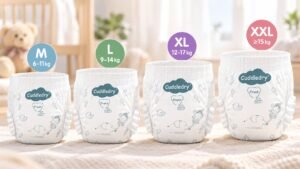
For example, a brand might offer different pack counts for S, M, L and XL products.
The appropriate quantities should be based on product dimensions, packaging capabilities and market demand.
How Should Importers Select Pack Sizes?
Research local retail shelves and compare:
- Common pack quantities
- Retail selling prices
- Price per diaper
- Customer purchasing habits
- Supermarket shelf requirements
- E-commerce shipping considerations
Buyer tip: Compare price per diaper as well as the total retail pack price when evaluating competitors.
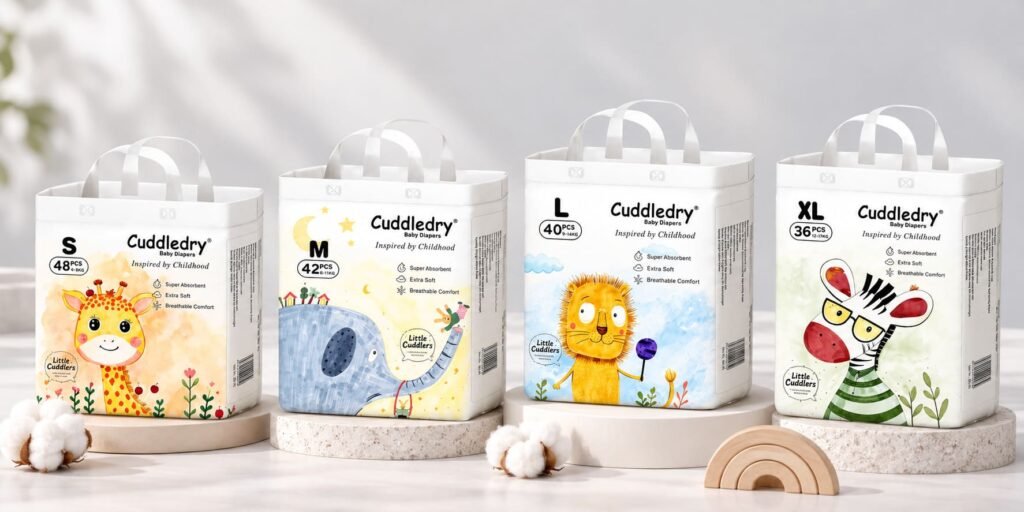
5. OEM Baby Diaper Packaging Design and Branding
For private label buyers, packaging design is one of the most visible parts of brand development.
A strong packaging system should help customers recognize the brand while making product information easy to understand.
Logo and Brand Identity
Use a consistent logo, brand name and visual identity across the product range.
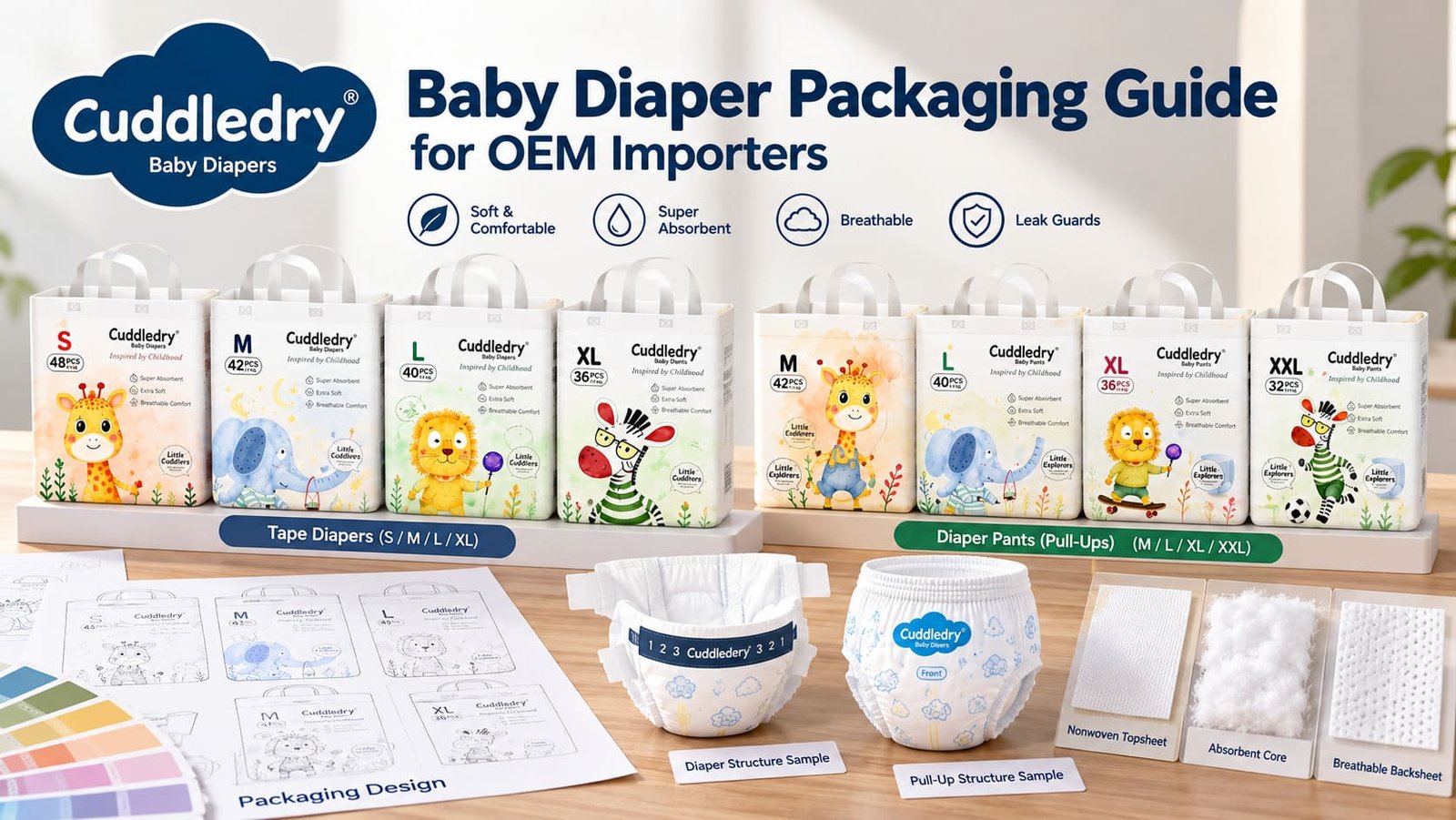
Color Coding by Size
Different colors can help customers distinguish between diaper sizes.
For example, a brand may use one color for S and another for M, L or XL.
The specific color system should be developed around the brand’s overall visual identity.
Product Type Identification
Packaging should clearly distinguish between tape diapers and diaper pants.
Front-of-Pack Information
Common information may include:
- Brand name
- Product type
- Diaper size
- Recommended weight range
- Number of diapers
- Verified product features
Back-of-Pack Information
Depending on the market, the back of the packaging may include:
- Product description
- Usage instructions
- Storage instructions
- Manufacturer or importer information
- Country of origin
- Barcode
- Batch identification
- Required warnings or regulatory information
All information should be reviewed for accuracy and compliance with the destination market’s requirements.
For buyers developing their own brand, our private label baby diapers guide explains the broader OEM development process.
6. Baby Diaper Packaging Printing Methods and Color Requirements
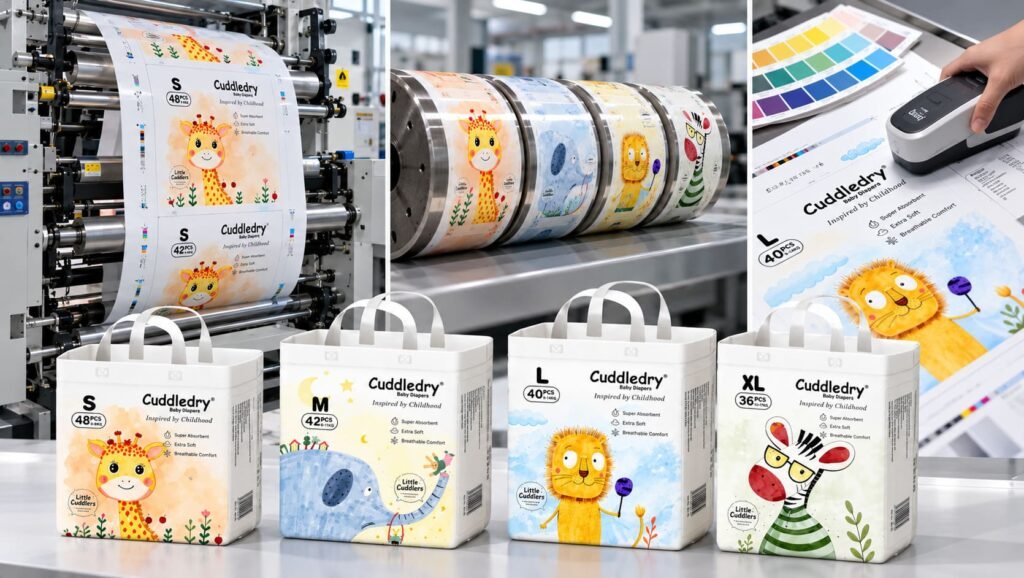
Printing quality has a major influence on the final appearance of retail packaging.
Importers should understand the printing method, color requirements and production limitations before approving artwork.
Gravure Printing
Rotogravure printing is commonly used in flexible packaging production, particularly for repeated production runs.
It uses engraved cylinders to transfer ink onto the packaging material.
Depending on the design and supplier, separate printing cylinders may be required for different colors.
Flexographic Printing
Flexographic printing uses flexible printing plates.
It can be suitable for various flexible packaging applications, depending on the supplier’s equipment and artwork requirements.
Digital Printing
Digital printing may be available for certain packaging applications and shorter production runs.
However, availability, material compatibility and unit costs vary by supplier.
CMYK and Pantone Colors
Packaging artwork may use CMYK printing or specified spot colors.
Pantone references can help communicate color expectations, but the final printed appearance also depends on ink, substrate and printing conditions.
Why Printed Samples Matter
Colors displayed on computer screens may differ from colors printed on packaging film.
Before mass production, buyers should review an appropriate printed proof or production sample.
Buyer tip: Approve packaging colors using a physical reference whenever color consistency is commercially important.
7. What Are Packaging Plate Fees and Why Do Manufacturers Charge Them?
Packaging plate fees are a common topic in OEM diaper projects.
Importers sometimes assume that a packaging supplier can print any design without additional setup costs.
However, certain printing methods require physical printing cylinders or plates.
What Is a Packaging Plate Fee?
A packaging plate fee is a charge associated with preparing the printing components required for a specific design.
For gravure printing, this may involve producing engraved printing cylinders.
For flexographic printing, it may involve preparing printing plates.
Why Does the Fee Vary?
The cost can depend on:
- Printing method
- Number of printing colors
- Packaging dimensions
- Artwork complexity
- Supplier equipment
- Whether existing printing components can be reused
Is the Plate Fee Charged for Every Order?
Not necessarily.
If the same approved design and printing components can be reused, repeat orders may not require a new set of plates or cylinders.
However, changes to artwork, packaging dimensions or printing specifications may create additional setup costs.
Who Owns the Printing Plates?
Ownership, storage, maintenance and reuse arrangements should be confirmed with the supplier.
Buyers should not assume that paying a plate fee automatically gives them unrestricted physical possession of the printing components.
Questions Importers Should Ask
- Is the plate fee included in the quotation?
- How many printing colors are included?
- Will the fee apply again to repeat orders?
- How long will the plates or cylinders be stored?
- What happens if the artwork changes?
Buyer tip: Confirm setup fees and repeat-order conditions before approving the final packaging artwork.
8. Barcodes and Labeling Requirements for Baby Diaper Packaging
Barcodes help identify products throughout retail and distribution systems.
For private label diaper brands, barcode planning should be completed before final packaging artwork is approved.
What Is a GTIN?
A Global Trade Item Number (GTIN) is used to identify trade items.
GTINs can be represented using different barcode symbols, depending on the application and market.
For example, EAN-13 and UPC-A are commonly used for retail products in relevant markets.
Does Every Diaper Size Need a Different Barcode?
Different retail products generally require distinct identifiers.
For example, S-size and M-size diaper packs are different trade items.
Different declared pack quantities may also require different GTINs.
Buyers should follow the applicable GS1 identification rules rather than assigning numbers arbitrarily.
The official GS1 guide to creating a GTIN provides useful information for brand owners.
Barcode Artwork Requirements
Before printing, buyers should verify:
- Correct GTIN assignment
- Barcode symbol type
- Barcode dimensions
- Quiet zones
- Print contrast
- Placement on the package
- Scan readability
Country-Specific Labeling Requirements
Different countries may have different requirements concerning product labeling, language, importer identification, origin information and product claims.
Some markets may also have additional registration, traceability or marking requirements.
Importers should verify applicable rules with their local regulatory advisers or relevant authorities.
Buyer tip: Do not finalize mass-printing artwork until barcode and destination-market labeling requirements have been reviewed.
9. How Baby Diaper Packaging Affects MOQ
Minimum Order Quantity (MOQ) is an important factor in private label diaper manufacturing.
Packaging customization can influence MOQ because printed packaging materials may need to be ordered separately from the diaper production process.
Packaging Supplier MOQ
Packaging suppliers may require minimum production quantities for customized film or printed bags.
MOQ by Packaging Design
Different diaper sizes may use different packaging dimensions and artwork.
As a result, each packaging design may have its own minimum production requirement.
MOQ by Printing Method
Printing setup requirements can influence the economic order quantity for a particular design.
Ready-Stock vs. Customized Packaging
Ready-stock branded products may offer different order arrangements from fully customized private label packaging.
However, availability and MOQ depend on the supplier’s actual product range and production arrangements.
How Can Importers Manage MOQ?
Buyers may consider:
- Starting with fewer product sizes
- Using a consistent packaging design system
- Reducing unnecessary packaging variations
- Confirming packaging MOQ before artwork development
- Planning repeat orders around expected sales
For new importers, a manageable initial product range can reduce complexity.
10. How Packaging Materials and Design Affect Costs
Packaging cost depends on more than the size of the plastic bag.
Several factors influence the final packaging quotation.
Material Type
Different film structures and material grades may have different prices.
Film Thickness
Thickness influences material usage and may affect packaging performance.
Printing Requirements
The number of colors, printing method and artwork complexity can affect setup and production costs.
Pack Dimensions
Larger packs generally require more packaging material, although the exact relationship depends on the design.
Order Quantity
Setup costs and production efficiency can affect the unit cost at different order quantities.
Additional Features
Handles, special closures, surface finishes or other packaging features may create additional costs.
How Should Buyers Compare Packaging Quotations?
Importers should request quotations based on equivalent specifications.
For example, compare the same material structure, film thickness, printing colors, pack dimensions and order quantity.
Buyer tip: Ask suppliers to identify one-time setup costs separately from recurring unit costs whenever possible.
11. Outer Cartons, Pallets and Container Loading
Retail packaging is only one part of the packaging system.
For international shipments, importers must also consider outer cartons and container loading.
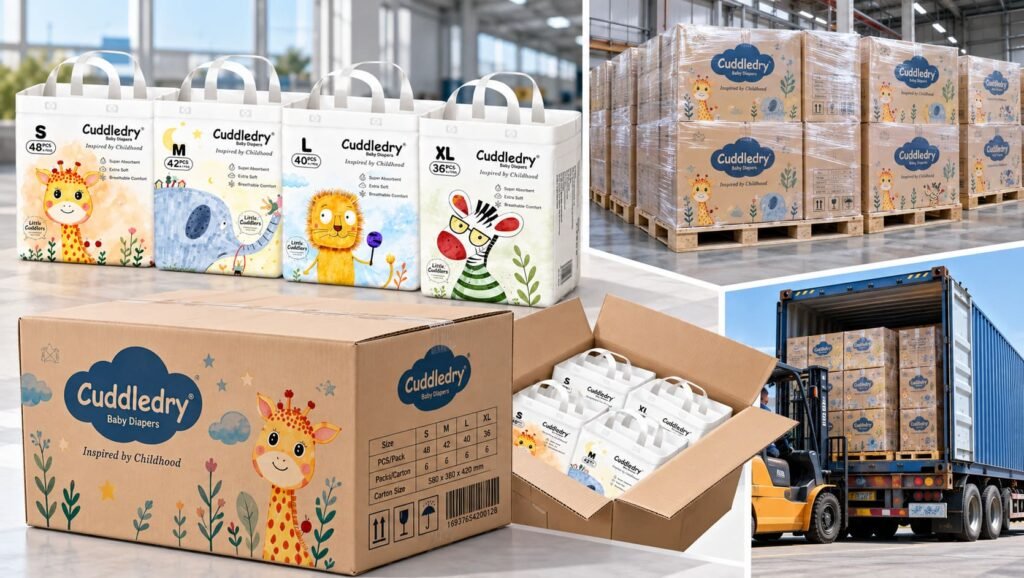
Outer Carton Specifications
Important details include:
- Carton dimensions
- Carton strength
- Packs per carton
- Gross weight
- Carton markings
- Handling and storage requirements
Why Carton Dimensions Matter
Carton dimensions influence warehouse storage and shipping efficiency.
Two products with similar diaper quantities may occupy different shipment volumes because of packaging design.
Container Loading
Importers should request a loading calculation based on actual carton measurements.
The final loading quantity depends on carton dimensions, weight limits, loading method and any palletization requirements.
Mixed-Size Orders
Different diaper sizes may use different pack quantities and carton dimensions.
When planning mixed-size shipments, buyers should confirm the quantity and carton specifications for each SKU.
Buyer tip: Review packaging and container loading together before confirming your final wholesale order.
12. Seven Essential Tips for OEM Baby Diaper Packaging
Tip 1: Research Your Target Market
Study local retail packaging formats, preferred pack quantities and competitor positioning.
Tip 2: Select Packaging Materials Before Finalizing Artwork
Material choice can affect printing, dimensions, appearance and cost.
Tip 3: Keep Branding Consistent Across Sizes
Use a clear visual system so customers can recognize the brand and identify different sizes.
Tip 4: Confirm All Mandatory Labeling Information
Check destination-market requirements before approving packaging artwork.
Tip 5: Verify Barcodes Before Printing
Ensure each retail SKU has the appropriate product identifier and a scannable barcode.
Tip 6: Understand MOQ and Printing Setup Fees
Ask about packaging minimum quantities, plate fees and repeat-order conditions.
Tip 7: Approve Physical Samples Before Mass Production
Review printing colors, sealing quality, dimensions and finished appearance before authorizing bulk production.
Key takeaway: Successful OEM packaging combines attractive branding with accurate information, suitable materials and practical manufacturing requirements.
13. Common Mistakes Importers Make with Baby Diaper Packaging
Packaging mistakes can create additional costs and delay product launches.
Mistake 1: Designing Packaging Before Confirming Dimensions
Artwork should be based on the approved packaging structure and dimensions.
Mistake 2: Ignoring Printing Limitations
Not every design can be reproduced identically on every material or printing system.
Mistake 3: Forgetting Barcode Requirements
Incorrect or unreadable barcodes can create retail and logistics problems.
Mistake 4: Making Unsupported Product Claims
Statements about product performance, materials or environmental benefits should be supported by appropriate evidence.
Mistake 5: Underestimating Packaging MOQ
Custom packaging may have separate minimum production requirements.
Mistake 6: Ignoring Carton Dimensions
Packaging choices can affect shipping volume and landed cost.
Mistake 7: Approving Artwork Without a Final Proof
Printing errors are often more expensive to correct after mass production has started.
Importers should establish a clear artwork approval process before confirming production.
14. How to Check Baby Diaper Packaging Quality Before Shipment
Packaging quality control is an important part of the finished-product inspection process.
Before shipment, buyers should verify that the packaging matches the approved specifications.
Artwork and Printing
Check logos, text, colors and product information against the approved artwork.
Pack Quantity
Verify that each retail pack contains the declared number of diapers.
Sealing Quality
Inspect the seals for visible defects and evaluate their suitability using the agreed inspection method.
Barcode Readability
Check barcode printing and scan performance.
Packaging Dimensions
Confirm that finished packs and outer cartons meet the agreed dimensional requirements.
Carton Markings
Verify product identification, carton quantity and any required shipping marks.
Production Consistency
Inspect samples from the production batch rather than relying only on the original packaging prototype.
Buyers should agree on acceptance criteria and inspection procedures before production.
For more information about supplier evaluation, read our guide to choosing a reliable baby diaper manufacturer in China.
15. How Cuddledry Supports Private Label Baby Diaper Packaging Projects
At Cuddledry, we understand that packaging is an important part of developing a successful baby diaper brand.
For importers, distributors and OEM customers, packaging decisions should support both brand presentation and practical purchasing requirements.
Our team can discuss your product and packaging needs to help identify suitable options for your project.
Depending on the requirements, discussions may include:
- Baby tape diaper and diaper pants packaging
- Retail pack quantities
- Packaging material options
- Packaging dimensions
- Private label artwork requirements
- Printing colors and finishes
- Barcode placement
- Packaging MOQ
- Printing setup costs
- Outer carton specifications
- Container loading considerations
Whether you are developing a new diaper brand or expanding an existing product range, careful packaging planning can help reduce avoidable costs and improve the purchasing process.
If you are preparing to launch your own brand, our guide on how to start a baby diaper brand explains the broader development process.
Frequently Asked Questions About Baby Diaper Packaging
What materials are commonly used for baby diaper packaging?
Flexible plastic films, including polyethylene-based and laminated structures, are commonly used. The suitable material depends on the product and packaging requirements.
Can I customize baby diaper packaging with my own brand?
Private label packaging customization may include logos, colors, artwork, pack quantities and product information, depending on the manufacturer’s capabilities and MOQ.
What is the MOQ for custom diaper packaging?
MOQ varies by packaging material, dimensions, printing method and supplier. Buyers should confirm packaging MOQ separately from diaper production MOQ.
What is a packaging plate fee?
A plate fee is a setup charge associated with preparing printing plates or cylinders for certain printing methods.
Do I need to pay the plate fee again for repeat orders?
Not always. Reuse depends on the printing method, artwork, packaging specifications and supplier agreement.
Can I use Pantone colors for diaper packaging?
Specified Pantone colors may be used as color references, subject to the printing method and supplier capabilities. Physical print approval is recommended.
Does each diaper size need a different barcode?
Different retail SKUs generally require distinct product identifiers. Buyers should follow the applicable GS1 GTIN allocation rules.
Can I print biodegradable or recyclable claims on the packaging?
Environmental claims should be supported by appropriate evidence and comply with the regulations of the destination market.
Can different diaper sizes share the same packaging design?
They can share a consistent visual identity, but size-specific information, dimensions and product identifiers may need to differ.
How can I reduce baby diaper packaging costs?
Consider simplifying packaging variations, selecting suitable materials, optimizing pack dimensions and planning order quantities around realistic sales forecasts.
Request Custom Baby Diaper Packaging and OEM Quotation
Are you developing your own baby diaper brand or looking for a supplier that can discuss private label packaging requirements?
Understanding baby diaper packaging materials, printing, MOQ and labeling requirements can help you make more informed purchasing decisions.
Contact Cuddledry to discuss your target market, packaging design, product specifications and wholesale order requirements.