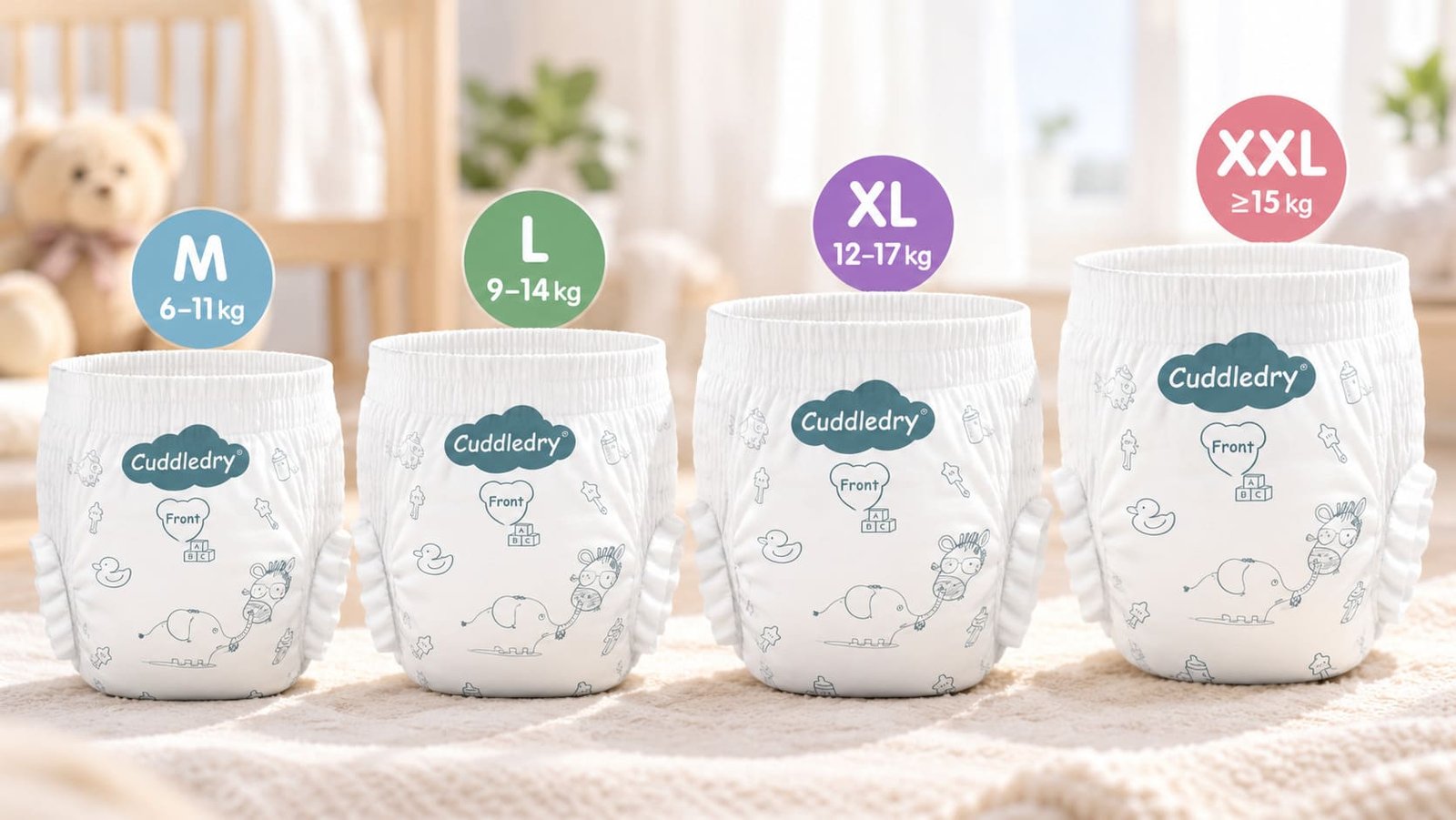
Understanding baby diaper sizes is an essential part of successful diaper importing and wholesale distribution. Choosing the right size range and order quantities can help importers meet customer demand, manage inventory and reduce unnecessary purchasing risks.
For new diaper distributors, selecting the right product sizes can be more complicated than it first appears. Different brands may use different sizing standards, and customer preferences can vary between markets.
Should you order more medium or large diapers? Do newborn sizes sell as quickly as larger sizes? Should baby diaper pants follow the same size distribution as tape diapers?
These questions are important when planning your first container order or developing a private label diaper brand.
In this guide, we explain how baby diaper sizing works, how importers can evaluate market demand and seven practical tips for planning wholesale diaper orders.
Table of Contents
- Understanding Baby Diaper Sizes
- Baby Diaper Size Chart
- Why Diaper Sizes Differ Between Brands
- Tape Diapers vs. Diaper Pants
- Which Diaper Sizes Sell Best?
- How to Plan Your Size Ratio
- Seven Essential Tips for Importers
- MOQ Requirements by Diaper Size
- Packaging and Container Loading
- Avoiding Inventory Problems
- Choosing Sizes for Private Label Diapers
- How to Check Diaper Fit and Quality
- How Cuddledry Supports Importers
- Frequently Asked Questions
1. Understanding Baby Diaper Sizes
Disposable baby diapers are commonly available in sizes such as Newborn, S, M, L, XL and XXL.
These sizes are generally associated with recommended baby weight ranges, but there is no single universal sizing chart used by every manufacturer.
For this reason, importers should not assume that a medium diaper from one supplier will have exactly the same dimensions or fit as a medium diaper from another supplier.
Why Baby Weight Matters
Baby weight is commonly used as a starting point for diaper size selection because it provides a practical reference for caregivers.
However, weight alone does not determine the ideal fit.
Babies of similar weight may have different body shapes, waist measurements and thigh proportions.
A suitable diaper should provide enough room for movement while maintaining appropriate contact around the waist and legs.
Why Importers Need to Understand Sizing
For wholesale buyers, diaper sizes influence:
- Product selection
- Retail customer demand
- Inventory turnover
- Order quantities
- Packaging requirements
- Container loading
- Customer satisfaction
Understanding these factors can help importers develop a more practical purchasing strategy.
2. Baby Diaper Size Chart: Newborn to XXL
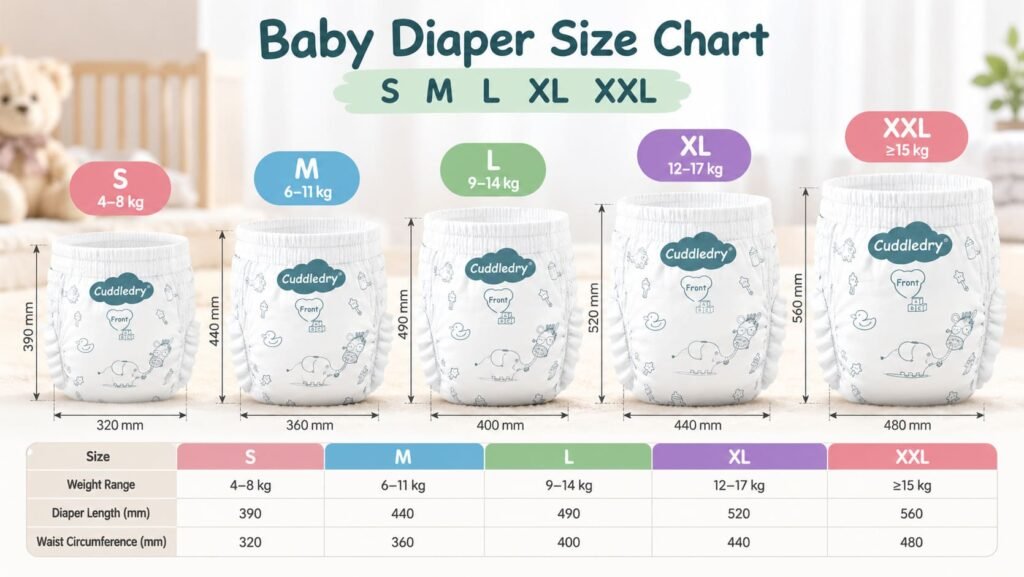
The following table provides an illustrative overview of weight ranges sometimes associated with common disposable baby diaper sizes.
Important: This is a general reference only. It is not the official Cuddledry size chart. Actual recommended weight ranges and product dimensions must be confirmed using the specific manufacturer’s approved product specifications.
| Diaper Size | Illustrative Weight Range | Typical Product Positioning |
|---|---|---|
| Newborn / NB | Up to approximately 5 kg | Newborn babies |
| S | Approximately 4–8 kg | Smaller babies |
| M | Approximately 6–11 kg | Growing babies |
| L | Approximately 9–14 kg | Larger babies and toddlers |
| XL | Approximately 12–17 kg | Toddlers |
| XXL | Approximately 15 kg and above | Larger toddlers and children |
The overlapping weight ranges are intentional. Different body shapes and product designs mean that more than one size may be suitable near a size transition.
Before printing packaging or confirming bulk orders, importers should request the official size chart for the selected product.
3. Why Baby Diaper Sizes Differ Between Brands
Although many brands use familiar size labels such as S, M and L, their actual product dimensions may differ.
Several factors contribute to these differences.
Product Design
Manufacturers may use different diaper shapes, absorbent core dimensions and fastening structures.
Elastic Components
Waist and leg elastics influence how a diaper fits different body shapes.
Absorbent Core Structure
Core thickness and flexibility can influence the overall fit and feel of a diaper.
Target Market
Manufacturers may develop product specifications based on the preferences and requirements of particular markets.
Tape Diapers and Diaper Pants
Different product types may have different fit characteristics, even when they use similar size labels.
For importers, this means that a size label should never replace a proper review of the product specification.
4. Tape Diapers vs. Diaper Pants: Are the Sizes the Same?
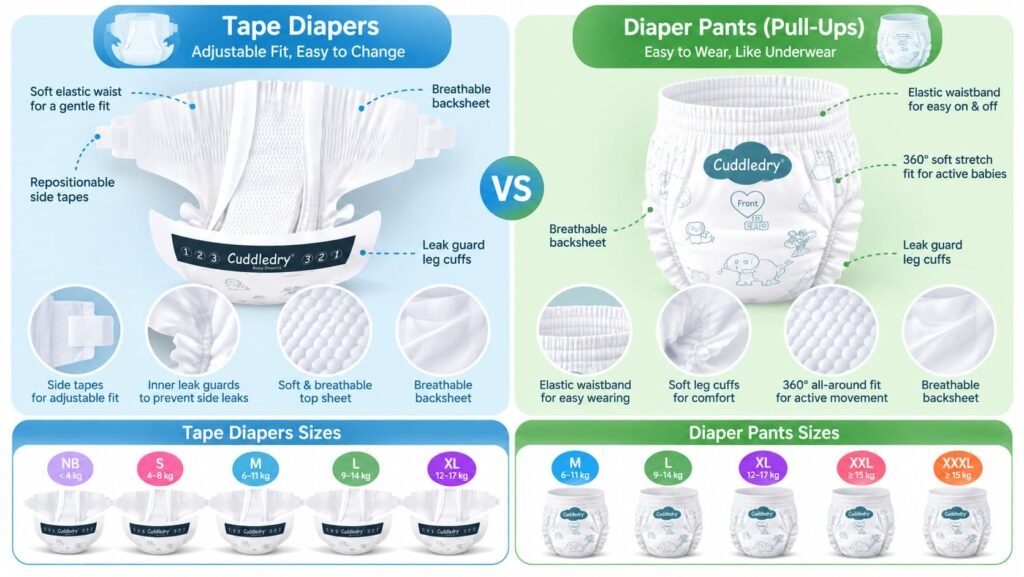
Baby tape diapers and diaper pants are two major product categories in the disposable diaper market.
Although both products may use size labels such as M, L and XL, their construction and fit are different.
Baby Tape Diapers
Tape diapers use fastening tabs that allow caregivers to adjust the waist fit.
They are commonly used for younger babies, although they may also be suitable for older babies depending on the product and caregiver preferences.
Baby Diaper Pants
Diaper pants have an elastic waistband and are designed to be pulled on like underwear.
They are often selected for active babies and toddlers.
What Should Importers Consider?
When planning a wholesale order, buyers should evaluate:
- Demand for tape diapers versus diaper pants
- Available size ranges
- Differences in packaging quantities
- Product fit and waistband construction
- Retail price positioning
Buyer tip: Do not automatically use the same size ratio for tape diapers and diaper pants.
5. Which Baby Diaper Sizes Sell Best?
One of the most common questions from new importers is which baby diaper sizes they should order in the largest quantities.
There is no universal answer.
The best-selling sizes depend on the country, retail channel, product type, customer demographics and purchasing habits.
Newborn and Small Sizes
Newborn and smaller sizes serve a specific stage of infant development.
Babies may move through these sizes relatively quickly, but demand depends on local birth rates, brand preferences and retail availability.
Medium and Large Sizes
Medium and large sizes are important parts of many diaper product ranges.
However, importers should confirm their relative sales volumes using actual market information rather than assuming one size always sells best.
XL and XXL Sizes
Larger sizes may be particularly relevant for older babies and toddlers.
Demand can also depend on the popularity of diaper pants and local toilet-training practices.
How Can Importers Identify Demand?
Useful information sources include:
- Sales records from existing distributors
- Retailer purchasing data
- Customer surveys
- Local supermarket observations
- Online marketplace sales information
- Historical sales of comparable products
Whenever possible, use actual sales data to determine the initial size mix.
6. How to Plan Your Baby Diaper Size Ratio for Wholesale Orders
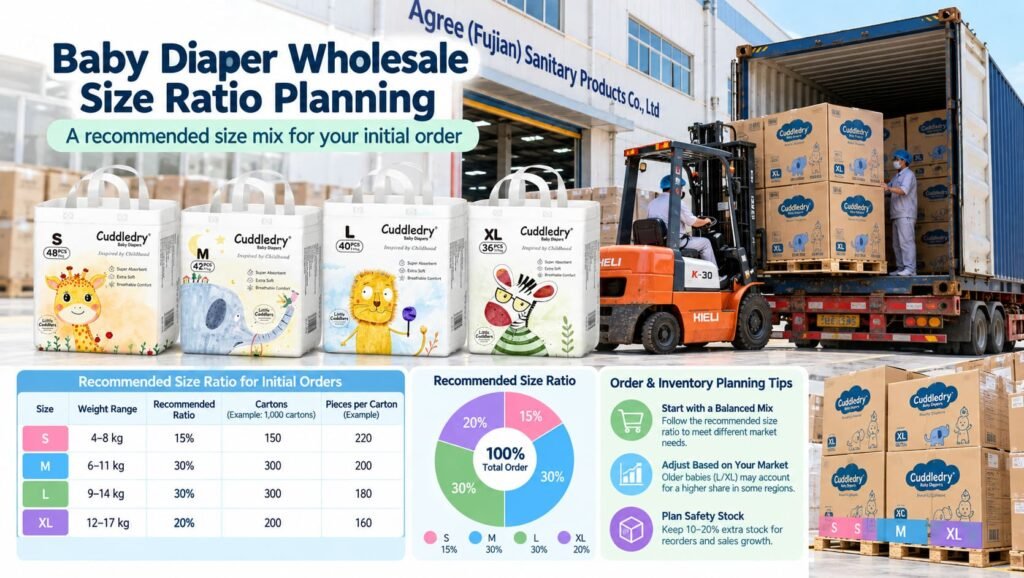
A size ratio describes how an order is divided between different diaper sizes.
For example, a distributor purchasing five sizes may need to decide what percentage of the total order should be allocated to each size.
Example of an Initial Size Allocation
The following example is a hypothetical planning exercise, not an industry benchmark or recommended Cuddledry order ratio.
| Size | Illustrative Allocation |
|---|---|
| S | 10% |
| M | 25% |
| L | 30% |
| XL | 25% |
| XXL | 10% |
Important: These percentages are included only to demonstrate how an order can be allocated. They should not be used as purchasing recommendations without supporting market data.
Calculate Quantities from Your Total Order
Suppose an importer plans to purchase 10,000 packs of diapers.
Using the hypothetical allocation above:
- S: 1,000 packs
- M: 2,500 packs
- L: 3,000 packs
- XL: 2,500 packs
- XXL: 1,000 packs
The final quantities must also be adjusted to meet supplier MOQ, carton packing and container-loading requirements.
Review the Ratio After Sales Begin
Once products reach the market, actual sales data should replace initial assumptions.
Importers can then adjust future orders to improve inventory turnover.
7. Seven Essential Tips for Choosing Baby Diaper Sizes
Tip 1: Research Your Local Market
Study local retail demand before choosing an order ratio.
Different markets may have different preferences for diaper sizes and product types.
Tip 2: Confirm the Manufacturer’s Official Size Chart
Request approved weight ranges and dimensions for every size.
Do not rely solely on generic online sizing charts.
Tip 3: Evaluate Tape Diapers and Diaper Pants Separately
Different product types may have different customer demand patterns.
Tip 4: Start with a Manageable Product Range
For new importers, a focused product range may be easier to manage than too many sizes and packaging variations.
Tip 5: Check MOQ Requirements for Each Size
Some manufacturers may apply minimum order quantities separately to each size or packaging specification.
Confirm these requirements before finalizing your order.
Tip 6: Plan Inventory Based on Expected Sales
Estimate how long each size will remain in stock and how quickly it may need replenishment.
Tip 7: Review Sales Data and Adjust Future Orders
Use actual sell-through information to improve future size allocations.
Key takeaway: A successful diaper size strategy should be based on market demand, product specifications and realistic inventory planning.
8. How MOQ Requirements Affect Baby Diaper Sizes
Minimum Order Quantity (MOQ) is an important consideration when purchasing disposable baby diapers.
Importers should understand whether the supplier’s MOQ applies to the total order or separately to each size.
MOQ per Size
Some manufacturers require a minimum quantity for each diaper size.
This can affect buyers who want to purchase many sizes in small quantities.
MOQ for Customized Packaging
Private label orders may involve additional packaging requirements.
Different packaging designs, pack counts or printed materials may have their own minimum quantities.
MOQ for Ready-Stock Products
Ready-stock branded products may offer different purchasing arrangements from fully customized OEM orders.
Availability and minimum quantities depend on the supplier’s current product range and inventory.
Questions to Ask Your Supplier
- Is MOQ calculated per size or per order?
- Can different sizes be combined in one shipment?
- Does each packaging design have a separate MOQ?
- Are ready-stock products available?
- Can the initial order be adjusted based on market testing?
Understanding these details helps buyers avoid unexpected purchasing commitments.
9. How Diaper Sizes Affect Packaging and Container Loading
Different baby diaper sizes may have different product dimensions, pack quantities and carton measurements.
These differences can affect shipping efficiency.
Packaging Quantity
Retail packs may contain different numbers of diapers depending on the product size and brand positioning.
For example, a manufacturer may offer different pack counts for small and extra-large sizes.
The exact quantities should be confirmed for each product specification.
Carton Dimensions
Carton dimensions influence how many cartons can be loaded into a shipping container.
Mixed-Size Container Orders
Importers may want to combine several sizes in one container.
When planning mixed-size orders, buyers should request a packing list showing:
- Diaper size
- Packs per carton
- Carton dimensions
- Carton gross weight
- Total carton quantity
- Total shipment volume
Buyer tip: Calculate container loading using actual carton dimensions rather than estimating capacity from the total number of diaper packs.
10. How to Avoid Inventory Problems with Baby Diaper Sizes
Incorrect size allocation can create inventory challenges for distributors.
For example, some sizes may sell quickly while others remain in storage for longer periods.
Common Inventory Problems
- Ordering too many slow-moving sizes
- Running out of popular sizes
- Purchasing too many packaging variations
- Failing to account for replenishment lead times
- Using assumptions instead of actual sales data
How to Improve Inventory Planning
Importers can improve purchasing decisions by monitoring:
- Sales volume by size
- Inventory turnover
- Reorder frequency
- Supplier production lead time
- Shipping transit time
- Seasonal or promotional demand changes
Inventory planning should also consider product storage conditions and any applicable shelf-life or date-labeling requirements.
A practical purchasing strategy balances product availability with the financial cost of holding inventory.
11. Choosing Baby Diaper Sizes for Private Label Brands
For entrepreneurs developing a private label diaper brand, size selection is part of the broader product development process.
Before launching a new brand, buyers should consider which sizes are most relevant to their intended customers.
Define Your Target Customer
Are you targeting newborn care, general baby diaper retail or older babies and toddlers?
Your target customer influences the product range you should consider.
Choose Your Product Types
Decide whether your initial range will include tape diapers, diaper pants or both.
Confirm Packaging Requirements
Each size may require its own packaging information, including product size, recommended weight range and pack quantity.
Evaluate Customization Costs
Additional sizes and packaging variations may increase production complexity and initial investment.
For more information about developing your own brand, read our private label baby diapers OEM guide.
If you are still planning your first product launch, our article on how to start a baby diaper brand explains the broader business development process.
12. How to Check Baby Diaper Fit and Quality Before Ordering
Choosing the correct size is important, but buyers should also evaluate the quality and fit of the selected product.
Check Product Dimensions
Compare the manufacturer’s specifications for each size.
Evaluate Waist and Leg Elastics
Elastic components should support a suitable fit without excessive tightness.
Inspect Leakage Barriers
Check the construction of inner leakage barriers and leg cuffs.
Review Absorbent Core Performance
Absorption speed, rewet and retention are important quality characteristics.
Compare Multiple Samples
Testing several samples can help identify variation in dimensions, weight and construction.
Confirm Production Specifications
Approved samples should be supported by written specifications before bulk production.
Importers should also evaluate the manufacturer’s production experience and quality-control procedures.
For additional sourcing guidance, read our article on choosing a reliable baby diaper manufacturer in China.
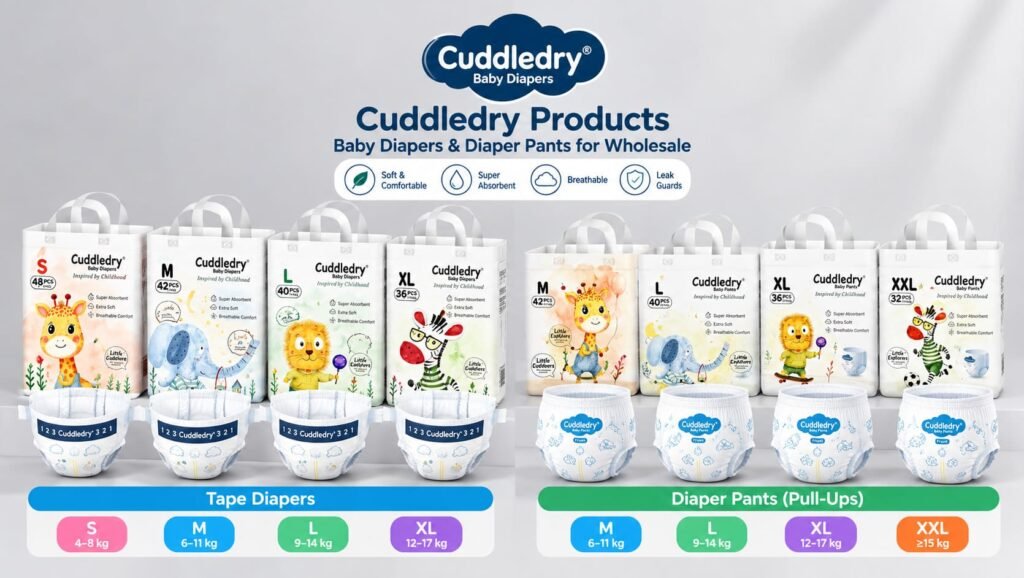
13. How Cuddledry Supports Baby Diaper Importers and Distributors
At Cuddledry, we understand that selecting the right baby diaper sizes is an important part of wholesale purchasing and brand development.
Importers need to consider more than product appearance. They also need suitable sizing, reliable product specifications and practical order planning.
Our team can discuss your target market and purchasing requirements to help identify suitable product options.
Depending on your project, these discussions may include:
- Baby tape diapers and diaper pants
- Available diaper sizes
- Product specifications
- Retail packaging quantities
- Private label packaging options
- Sample requests
- MOQ requirements
- Mixed-size order planning
- Container loading considerations
Whether you are expanding an existing diaper distribution business or developing a new private label brand, careful size selection can help create a stronger foundation for your purchasing strategy.
Frequently Asked Questions About Baby Diaper Sizes
What are the most common baby diaper sizes?
Common disposable baby diaper sizes include Newborn, S, M, L, XL and XXL. However, the available size range depends on the manufacturer and product type.
Are baby diaper sizes the same for every brand?
No. Different manufacturers may use different weight ranges, dimensions and product designs. Always check the official size chart for the specific product.
Which baby diaper size sells the most?
There is no universal best-selling size. Demand varies by market, retail channel, product type and customer demographics.
Should I order more M or L diapers?
The appropriate ratio depends on your target market and actual sales information. Importers should avoid using a fixed ratio without supporting demand data.
Are tape diaper and diaper pants sizes identical?
Not necessarily. Tape diapers and diaper pants use different constructions and may have different sizing specifications.
Can I mix different diaper sizes in one container?
Mixed-size orders may be possible depending on the supplier’s MOQ, packaging and shipping arrangements. Confirm the details before ordering.
Does MOQ apply separately to each diaper size?
It depends on the manufacturer and order type. Some suppliers apply MOQ per size, while others may offer different arrangements for ready-stock or customized products.
How can I choose the right size ratio for my first order?
Start by researching local demand, reviewing retailer sales information and confirming supplier requirements. Adjust future orders using actual sales data.
Can I customize diaper sizes for my own brand?
Customization options depend on the manufacturer’s equipment, product design and order requirements. Buyers should discuss technical feasibility and MOQ before proceeding.
Request Baby Diaper Samples and Wholesale Quotation
Are you planning to import baby diapers or develop your own private label diaper brand?
Choosing the right baby diaper sizes and order quantities can help you better serve your market and manage inventory more effectively.
Contact Cuddledry to discuss your target market, available sizes, product specifications, packaging options and wholesale requirements.