Baby diaper quality testing is one of the most important steps for importers, distributors and private label brand owners when evaluating a diaper manufacturer.
Two baby diapers may look almost identical, but their absorption speed, surface dryness, leakage protection and overall performance can be very different.
For buyers sourcing baby diapers from China, understanding how diapers are tested can help reduce purchasing risks, compare suppliers more effectively and select products that meet the expectations of their target market.
However, diaper quality cannot be judged by a single number. A product with high total absorption capacity may still experience leakage if liquid distribution, fit or rewet performance is poor.
In this guide, we explain seven essential baby diaper quality tests, what each test measures and how OEM buyers can use test results when making purchasing decisions.
Table of Contents
- Why Baby Diaper Quality Testing Matters
- Test 1: Absorption Speed
- Test 2: Rewet Performance
- Test 3: Absorption Capacity and Retention
- Test 4: Leakage Protection and Fit
- Test 5: Dimensions and Product Weight
- Test 6: Construction and Adhesion Quality
- Test 7: Production Consistency
- How to Compare Diaper Test Reports
- Common Quality Testing Mistakes
- Quality Control for OEM Orders
- What to Ask Your Diaper Manufacturer
- How Cuddledry Supports Buyers
- Frequently Asked Questions
1. Why Baby Diaper Quality Testing Matters
For baby diaper importers, product quality directly affects customer satisfaction, brand reputation and repeat purchases.
A diaper that looks attractive in its packaging may not necessarily perform well during everyday use.
For example, a diaper may feel extremely soft but have slow liquid acquisition. Another product may absorb a large amount of liquid in laboratory conditions but still leak because of poor fit.
This is why professional buyers should evaluate several performance characteristics together.
What Does Baby Diaper Quality Include?
Important quality characteristics include:
- Absorption speed: How quickly liquid enters the absorbent structure.
- Rewet performance: How much liquid returns toward the surface under defined conditions.
- Absorption capacity: How much liquid the product can hold under a specified test method.
- Leakage protection: How effectively the diaper contains liquid during use.
- Fit and comfort: How well the diaper adapts to movement and body shape.
- Construction quality: Whether components remain securely assembled.
- Production consistency: Whether different batches meet agreed specifications.
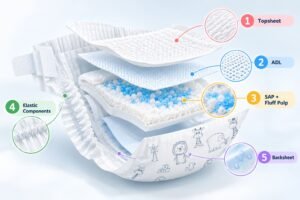
These characteristics are influenced by the materials used in the diaper, including SAP, fluff pulp, topsheet, acquisition distribution layer and backsheet.
Understanding the relationship between materials and performance helps importers communicate more effectively with manufacturers.
2. Test 1: Baby Diaper Absorption Speed
Absorption speed is one of the most commonly discussed indicators in baby diaper quality testing.
It describes how quickly a diaper receives a specified amount of test liquid under controlled conditions.
Why Is Absorption Speed Important?
When liquid enters a diaper, it should pass through the topsheet and move into the absorbent structure.
If liquid remains on the surface for too long, it may spread toward the edges before the absorbent core can receive it.
Efficient liquid acquisition can help improve the diaper’s overall liquid management.
How Is Absorption Speed Tested?
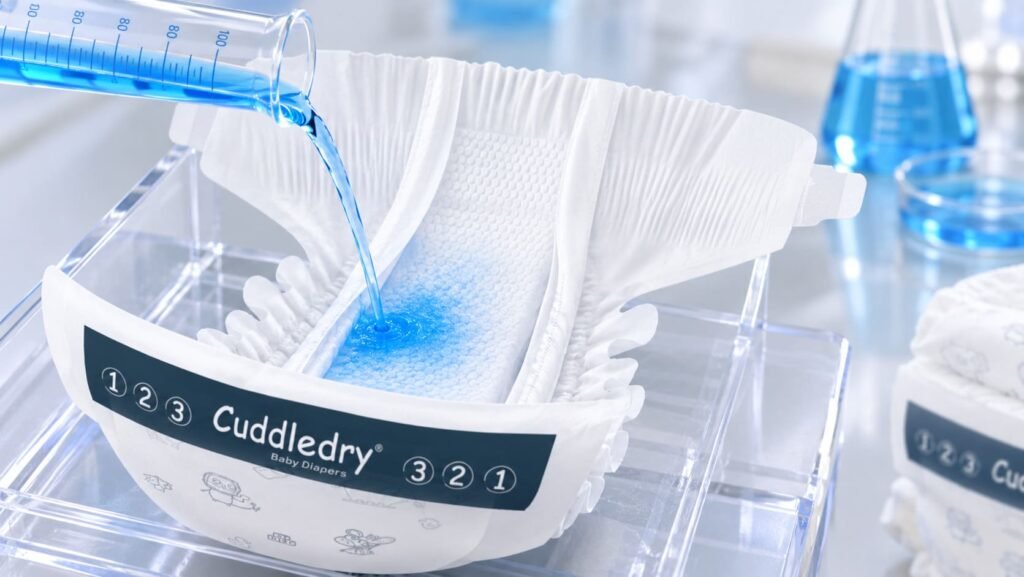
In a controlled laboratory procedure, technicians may apply a measured volume of test liquid to a specified area of the diaper and record the time required for the liquid to enter the product.
Depending on the method, the test may involve multiple liquid applications to evaluate performance after the core has already absorbed some moisture.
Important test conditions include:
- Type and composition of test liquid
- Liquid volume
- Liquid application rate
- Application position
- Time between repeated applications
- Sample conditioning
How Should Importers Interpret the Results?
Under the same test conditions, shorter acquisition times generally indicate faster liquid intake.
However, results from different laboratories should not be compared unless their testing methods are equivalent.
Buyer tip: Ask your supplier to provide both the result and the test method used.
3. Test 2: Rewet Performance and Surface Dryness
Rewet testing evaluates how much liquid returns from the absorbent structure toward the diaper surface under defined conditions.
This is an important indicator because a diaper can absorb liquid quickly while still allowing moisture to return to the surface.
What Is Rewet?
After liquid enters the diaper, some moisture may move back toward the topsheet when pressure is applied.
Rewet testing attempts to measure this effect in a controlled and repeatable way.
How Is Rewet Tested?
A typical laboratory approach involves applying a defined amount of liquid to the diaper, allowing a specified absorption period and then placing absorbent test material on the surface under a controlled load.
The increase in weight of the test material is used to estimate the amount of liquid transferred back toward the surface.
Different methods may use different loads, contact times and liquid application procedures.
What Does a Lower Rewet Result Mean?
Under equivalent test conditions, a lower rewet value generally indicates less liquid transfer back toward the surface.
However, a laboratory rewet result is not a direct measurement of skin health or a guarantee against diaper rash.
Actual skin conditions depend on several factors, including diaper-changing frequency, fit, hygiene and individual sensitivity.
Why Should Importers Check Rewet?
Rewet performance can help buyers evaluate:
- Liquid retention near the surface
- Absorbent core performance
- Differences between product specifications
- Consistency between samples
Buyer tip: Compare rewet results only when liquid volume, loading conditions and test procedures are consistent.

4. Test 3: Absorption Capacity and Liquid Retention
Absorption capacity describes the amount of liquid a diaper or its absorbent structure can absorb under a defined test procedure.
It is an important measurement, but it is often misunderstood.
Total Absorption Capacity
Some laboratory methods measure the amount of liquid a product absorbs after exposure to test liquid under specified conditions.
These tests can provide useful information about the absorbent system.
However, maximum laboratory absorption capacity should not be interpreted as the amount of liquid a baby can comfortably use in everyday conditions.
Absorption Under Pressure
During normal use, a diaper experiences pressure from sitting, crawling and other movements.
Absorption and retention under pressure may differ from measurements made without pressure.
This is one reason why testing the complete diaper is important.
Why More SAP Does Not Always Mean Better Performance
Super Absorbent Polymer (SAP) plays a major role in liquid retention.
However, the performance of the complete diaper also depends on liquid distribution, core structure and the interaction between different materials.
A diaper with more SAP does not automatically provide better leakage protection or surface dryness.
What Should Buyers Request?
- Test method and conditions
- Sample size and number of repetitions
- Absorption capacity results
- Retention-related measurements, where applicable
- Information about sample variability
Buyer tip: Do not compare maximum absorption figures from suppliers unless the same testing procedure was used.
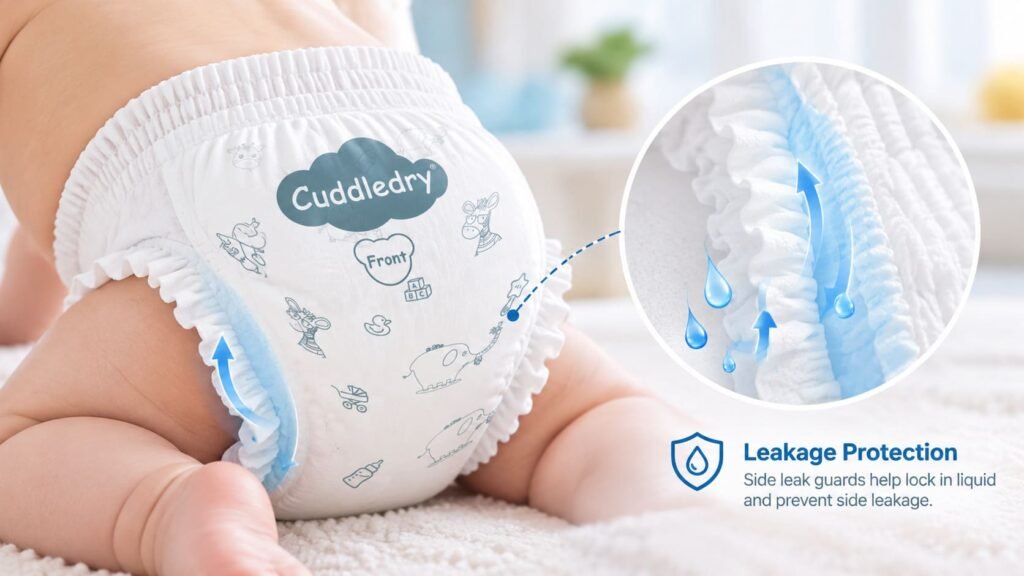
5. Test 4: Leakage Protection and Diaper Fit
Leakage protection is one of the most important aspects of baby diaper performance.
However, leakage cannot be evaluated only by measuring how much liquid the absorbent core can hold.
What Causes Diaper Leakage?
Leakage may result from several factors:
- Slow liquid acquisition
- Uneven liquid distribution
- Localized saturation
- Incorrect diaper size
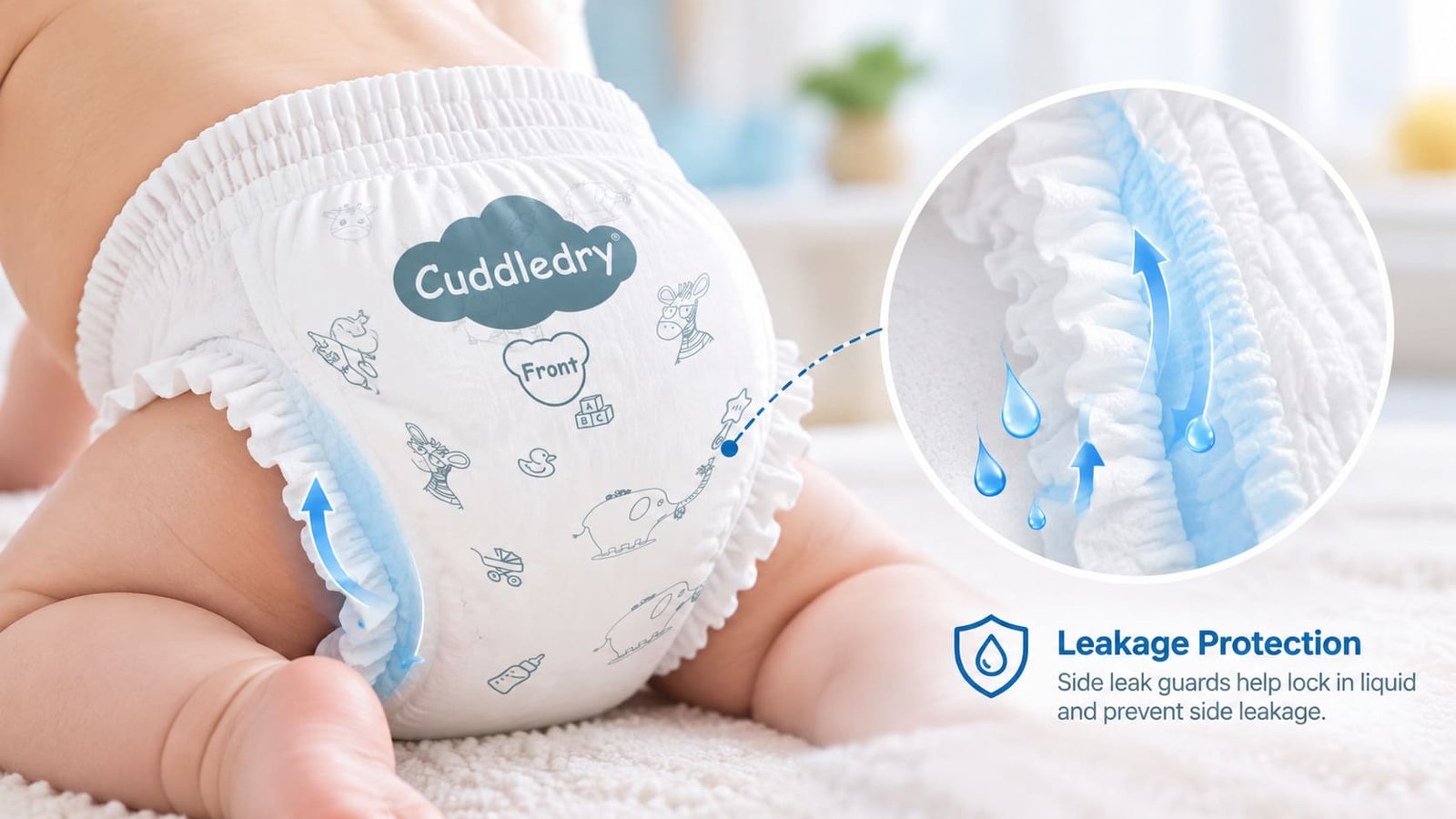
- Poor fit around the legs
- Insufficient barrier cuff performance
- Improper fastening
How Can Leakage Protection Be Evaluated?
Laboratory assessments may examine liquid containment under specified application and positioning conditions.
Physical inspection can also evaluate leg cuffs, elastic components and fastening systems.
For a more complete assessment, controlled user trials can provide additional information about performance during normal activities.
Why Is Fit Important?
Babies move frequently, and diapers must maintain a suitable fit during different activities.
Even a highly absorbent diaper may leak if gaps develop around the legs or waist.
Buyers should evaluate the diaper’s intended weight range, dimensions and elastic design.
Testing Tape Diapers and Diaper Pants
Tape diapers and diaper pants have different fastening and waistband structures.
Therefore, their fit-related assessments may require different procedures.
Buyer tip: When comparing leakage performance, consider both laboratory results and the intended product design.
6. Test 5: Diaper Dimensions, Weight and Size Consistency
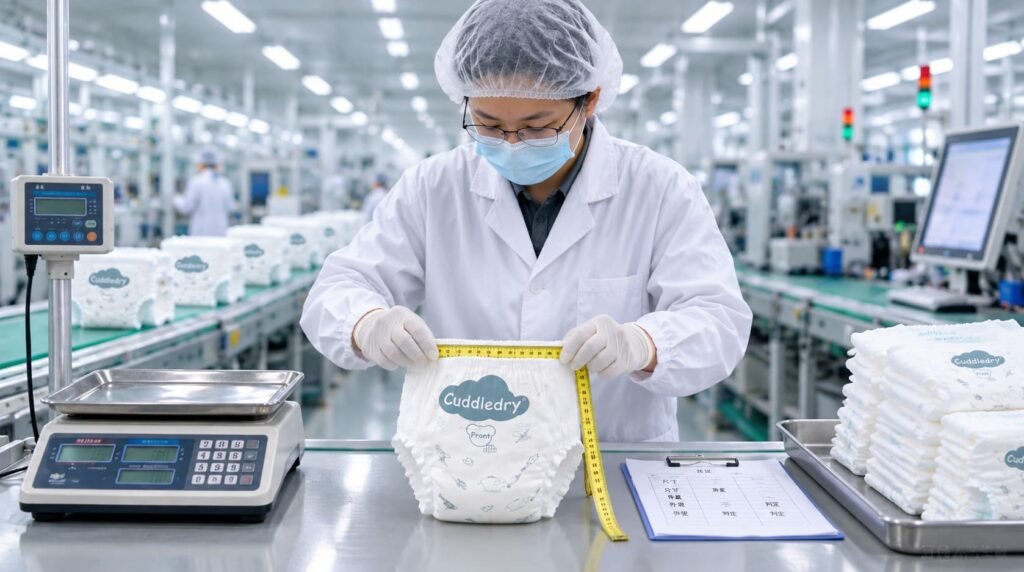
Product dimensions and weight are important quality-control measurements for disposable baby diapers.
These measurements help manufacturers verify whether finished products match the agreed specifications.
Common Measurements
Depending on the diaper design, inspections may include:
- Overall diaper length
- Overall width
- Absorbent core length and width
- Product weight
- Waistband dimensions
- Fastening tape position
- Leg cuff dimensions
Why Does Product Weight Matter?
Product weight can be a useful consistency indicator when comparing diapers made to the same specification.
Unexpected weight variations may indicate changes in material quantities or production conditions.
However, heavier diapers are not automatically better diapers.
Why Are Dimensional Tolerances Important?
Manufacturing processes naturally involve some variation.
For this reason, buyers and manufacturers should agree on acceptable tolerances before production.
Measurements outside agreed tolerances may affect fit, appearance or packaging consistency.
Buyer tip: Ask for a written product specification sheet with dimensions, target weight and agreed tolerances.
7. Test 6: Construction, Adhesion and Component Integrity
Baby diapers contain multiple components that must remain properly assembled during normal handling and use.
Construction quality is therefore an important part of the inspection process.
What Should Be Checked?
Common inspection points include:
- Topsheet and backsheet bonding
- Absorbent core positioning
- Elastic attachment
- Leakage barrier cuff construction
- Fastening tape attachment
- Waistband integrity
- Visible defects or contamination
Why Does Adhesion Quality Matter?
Specialized adhesives are commonly used to assemble disposable diapers.
If components are not properly bonded, the diaper may experience construction defects or reduced durability.
Fastening System Checks
For tape diapers, inspectors may evaluate whether fastening components attach securely and function as intended.
For diaper pants, inspections may focus on waistband and side-seam integrity.
Visual Inspection
Visual checks can help identify:
- Misaligned components
- Damaged materials
- Uneven construction
- Printing defects
- Packaging defects
Buyer tip: Agree on critical, major and minor defect definitions before mass production.
8. Test 7: Production Consistency and Batch Quality Control
One good sample does not guarantee that every diaper in a bulk order will have the same quality.
This is why production consistency is essential for OEM and wholesale buyers.
Why Is Batch Consistency Important?
Diaper production involves high-speed equipment, multiple raw materials and numerous manufacturing settings.
Changes in materials, equipment adjustments or process conditions can influence finished-product characteristics.
How Can Consistency Be Evaluated?
Manufacturers may use sampling and inspection procedures to monitor:
- Product dimensions
- Product weight
- Material placement
- Construction quality
- Absorption-related performance
- Packaging accuracy
- Visible defects
Pre-Production Samples vs. Bulk Production
Importers should distinguish between development samples and approved production specifications.
Once a product is approved, the manufacturer should work to maintain the agreed specifications during bulk production.
Why Documentation Matters
Inspection records can help buyers understand whether a manufacturer has a structured quality-control process.
Depending on the supplier and project, useful records may include:
- Approved specification sheets
- Sample approval records
- Production inspection records
- Finished-product test reports
- Corrective-action records
Buyer tip: Request clear acceptance criteria and agree on how nonconforming products will be handled.
9. How to Compare Baby Diaper Quality Test Reports
When sourcing from multiple suppliers, buyers may receive test reports showing different absorption and rewet values.
These figures can be useful, but only when the underlying testing conditions are understood.
Check the Test Method
First, identify which procedure was used.
Different methods may evaluate different characteristics of diaper performance.
Check the Test Liquid
Liquid composition can influence absorbent material behavior.
Results obtained using different test liquids may not be directly comparable.
Check the Number of Samples
A result based on one sample provides less information about variability than a properly designed sampling program.
Check the Testing Conditions
Important details may include:
- Temperature and sample conditioning
- Liquid volume
- Application rate
- Waiting time
- Applied pressure
- Number of repetitions
Check Who Performed the Test
Determine whether testing was conducted internally or by an independent laboratory.
Both types of testing can provide useful information, but buyers should understand the scope and limitations of each report.
Refer to Industry Testing Guidance
For more information, buyers can review the EDANA baby diaper testing guidelines.
These guidelines discuss important considerations for scientifically sound diaper testing, including sampling, test design and interpretation of results.
Important: A laboratory result should always be interpreted in relation to its specific test method. Different measurements should not be treated as interchangeable.
10. Common Mistakes Importers Make When Testing Baby Diapers
Even experienced buyers can make mistakes when comparing diaper samples.
Mistake 1: Comparing Only Maximum Absorption Capacity
A high maximum absorption figure does not automatically indicate better everyday performance.
Mistake 2: Ignoring Rewet
Absorption speed and surface dryness are different characteristics.
Both should be considered.
Mistake 3: Comparing Results from Different Test Methods
Numbers from different procedures may not be directly comparable.
Mistake 4: Testing Only One Diaper
A single sample cannot adequately represent production variability.
Mistake 5: Ignoring Fit and Leakage Protection
Absorbent core performance is only one part of the complete diaper’s performance.
Mistake 6: Choosing the Lowest Price Without Checking Specifications
Lower quotations may reflect different materials, product structures or manufacturing requirements.
Mistake 7: Failing to Confirm Production Specifications
Approved samples should be supported by clear written specifications.
For buyers who want to understand how raw materials influence these results, learning about SAP, fluff pulp and absorbent core structures is an important next step.
11. Baby Diaper Quality Control for OEM and Private Label Orders
For private label buyers, quality control should begin before mass production.
It is more effective to define product requirements early than to resolve specification disagreements after an order is completed.
Step 1: Define Your Product Requirements
Confirm the intended market, product positioning, diaper sizes and expected performance characteristics.
Step 2: Request Samples
Evaluate samples based on the characteristics that matter most for your market.
Step 3: Agree on Specifications
Document product dimensions, materials, packaging requirements and relevant performance criteria.
Step 4: Approve the Final Sample
Keep a clearly identified approved sample as a reference for production.
Step 5: Confirm Inspection Requirements
Agree on sampling procedures, inspection timing and acceptance criteria.
Step 6: Review Production Results
Request appropriate quality records and address any identified deviations.
Step 7: Confirm Packaging and Shipment Details
Check that the finished products and packaging correspond to the approved order requirements.
For additional information about customization, packaging and production planning, read our private label baby diapers OEM guide.
12. What Should You Ask a Baby Diaper Manufacturer About Quality Testing?
Before placing a bulk order, importers should ask their suppliers specific questions about product quality.
Useful questions include:
- Which absorption and rewet tests do you perform?
- Can you explain the test methods and conditions?
- Can you provide sample test reports?
- How do you monitor product dimensions and weight?
- What quality checks are performed during production?
- How are defective products identified and handled?
- Can we agree on written product specifications?
- Can independent inspection be arranged if required?
- How do you manage material or specification changes?
- What information is included in the final quality report?
A reliable supplier should be able to discuss these questions clearly and explain which tests are relevant to the requested product.
When evaluating manufacturers, buyers should consider production capabilities, communication, quality management and long-term reliability.
Our article on choosing a baby diaper manufacturer in China provides additional sourcing guidance.
13. How Cuddledry Supports Baby Diaper Importers
At Cuddledry, we understand that importers and brand owners need more than an attractive diaper design.
They need products with suitable specifications, reliable manufacturing and clear communication throughout the purchasing process.
When discussing a new project, our team can help buyers review their requirements and identify appropriate product options.
Depending on the project, these discussions may include:
- Baby tape diapers and diaper pants
- Product sizes and target markets
- Absorbent core specifications
- Softness and comfort requirements
- Absorption and rewet expectations
- Packaging customization
- Sample evaluation
- MOQ and bulk order planning
For new brand owners, product testing is an important part of developing a competitive product.
If you are planning to enter the diaper market, our guide on how to start a baby diaper brand explains the broader development process.
Frequently Asked Questions About Baby Diaper Quality Testing
What is the most important baby diaper quality test?
There is no single test that fully determines diaper quality. Absorption speed, rewet, retention, leakage protection, fit and manufacturing consistency should be considered together.
How is baby diaper absorption speed tested?
Absorption speed is commonly evaluated by applying a measured amount of test liquid to the diaper and recording the time required for liquid acquisition under defined conditions.
What is a diaper rewet test?
A rewet test evaluates how much liquid transfers back toward the diaper surface under specified loading and contact conditions.
Does higher absorption capacity mean better diaper quality?
Not necessarily. Maximum absorption capacity does not directly measure leakage protection, surface dryness or performance during normal use.
Can I compare diaper test reports from different factories?
Yes, but the results should be compared only after confirming that the methods, test liquids, sample preparation and other conditions are equivalent.
Why do baby diapers leak even when they have enough SAP?
Leakage may result from slow acquisition, uneven liquid distribution, localized saturation, poor fit or problems with leakage barriers.
Should importers arrange third-party diaper testing?
Independent testing can be useful when buyers need additional verification, particularly for new suppliers, product development or specific contractual requirements.
How can I confirm that bulk production matches approved samples?
Use written specifications, clearly identified approved samples, agreed inspection procedures and appropriate production quality records.
Request Baby Diaper Samples and OEM Specifications
Are you evaluating baby diaper manufacturers or developing your own private label diaper brand?
Baby diaper quality testing can help you make more informed purchasing decisions and reduce the risk of selecting unsuitable products.
Contact Cuddledry to discuss your target market, product specifications, sample requirements and OEM manufacturing options.