Private label baby diapers offer importers, distributors and entrepreneurs an opportunity to build their own brands without investing in diaper manufacturing equipment or production facilities. Instead of establishing a factory, businesses can work with an experienced OEM baby diaper manufacturer to develop products under their own brand names.
However, successful private label diaper manufacturing involves much more than printing a logo on packaging. Product specifications, absorbent materials, packaging design, minimum order quantities, quality control and international logistics all play important roles in developing a competitive diaper brand.
This guide explains how private label baby diapers are manufactured, what customization options are available and what importers should consider before placing their first order.
1. What Are Private Label Baby Diapers?
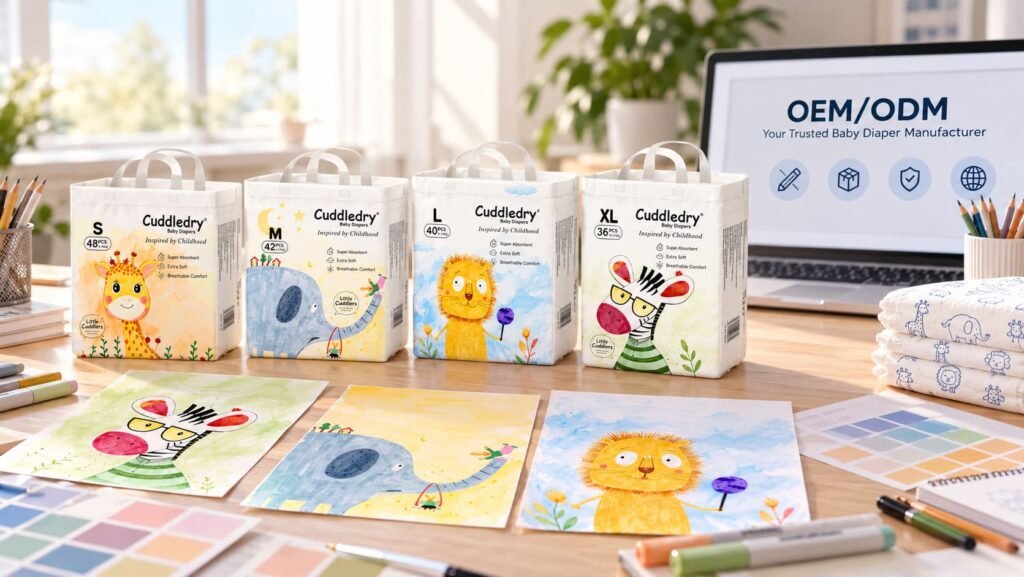
Private label baby diapers are diapers manufactured by one company and sold under another company’s brand. For example, a distributor in Africa, Europe, the Middle East or South America may want to introduce a baby diaper brand specifically designed for its local market. Instead of building a diaper factory, the distributor works with a manufacturer that provides production and customization services. The manufacturer produces the diapers according to agreed specifications, while the distributor markets and sells the products under its own brand. Depending on the manufacturer’s capabilities and the order quantity, customization may include:
- Brand name and logo
- Packaging design
- Diaper backsheet printing
- Absorbent core specifications
- Topsheet materials
- Waistband and elastic components
- Diaper sizes
- Pack quantities
- Product positioning
- Carton or bale packaging
The level of customization depends on production requirements, material availability and minimum order quantities. For many importers, private label manufacturing provides a practical way to enter the baby diaper market.
2. What Is the Difference Between OEM and ODM Baby Diapers?
The terms OEM and ODM are frequently used in the hygiene products industry. Although they are sometimes used interchangeably, they describe different manufacturing arrangements.
OEM Baby Diapers
OEM stands for Original Equipment Manufacturer. In an OEM arrangement, the buyer generally provides specific product requirements, branding or design instructions. The manufacturer produces the diapers according to the agreed specifications. For example, a buyer may request:
- A specific diaper weight
- A particular absorbent core structure
- A customized printed backsheet
- A defined size range
- Exclusive packaging artwork
OEM manufacturing is suitable for businesses that want greater control over product development.
ODM Baby Diapers
ODM stands for Original Design Manufacturer. Under an ODM arrangement, the manufacturer typically offers an existing product design or developed specification that the customer can adapt. The buyer may customize branding, packaging or selected product features without developing the entire product from the beginning.
ODM solutions can simplify the product development process, particularly for first-time importers.
Which Option Is Better?
Neither option is automatically better. OEM may be more suitable for established brands with detailed product specifications. ODM may be more convenient for new businesses that want to launch products using an existing manufacturing platform. The right choice depends on your market positioning, budget, order volume and customization requirements.
3. Why Are More Importers Choosing Private Label Diapers?
Private label baby diapers can offer several commercial advantages.
Greater Control Over Branding
Importers can develop their own brand identity instead of relying entirely on established international brands. This includes control over packaging appearance, marketing messages and brand positioning.
Product Customization
Different markets have different consumer expectations. A private label manufacturer can help buyers select product specifications suitable for their target customers.
Flexible Market Positioning
Private label diapers can be developed for economy, mid-range or premium market segments. The final specification should reflect the target selling price and consumer expectations.
Long-Term Brand Development
Owning a brand allows businesses to build recognition and customer loyalty over time. However, private label manufacturing does not automatically guarantee lower costs or higher profit margins. Commercial success still depends on product quality, pricing, distribution and marketing.
4. Choose the Right Private Label Diaper Product
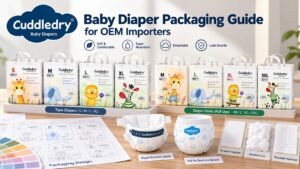
Before discussing packaging designs, importers should decide which products they want to sell. The two main categories are baby tape diapers and baby diaper pants.
Baby Tape Diapers
Baby tape diapers use adjustable fastening tapes. They are widely used for newborns and younger babies. Common product features include:
- Adjustable fastening tapes
- Soft topsheet
- Absorbent core
- Elastic leg cuffs
- Breathable backsheet
- Wetness indicator, where applicable
Tape diapers are available in different sizes and specifications.
Baby Diaper Pants
Baby diaper pants, also called pull-up diapers, are designed to be worn like underwear. They are particularly convenient for active babies and toddlers. Common features include:
- Elastic waistband
- Pull-up design
- Absorbent core
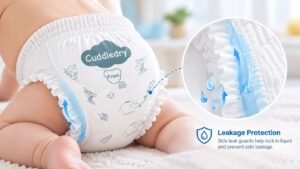
- Leakage protection
- Tear-away side seams, depending on design
- Soft and breathable materials
Some private label brands launch both tape diapers and diaper pants. Others begin with a smaller product range and expand after establishing market demand. For first-time importers, selecting the right initial product range is an important part of controlling inventory and investment.
5. Understanding Baby Diaper Materials and Specifications
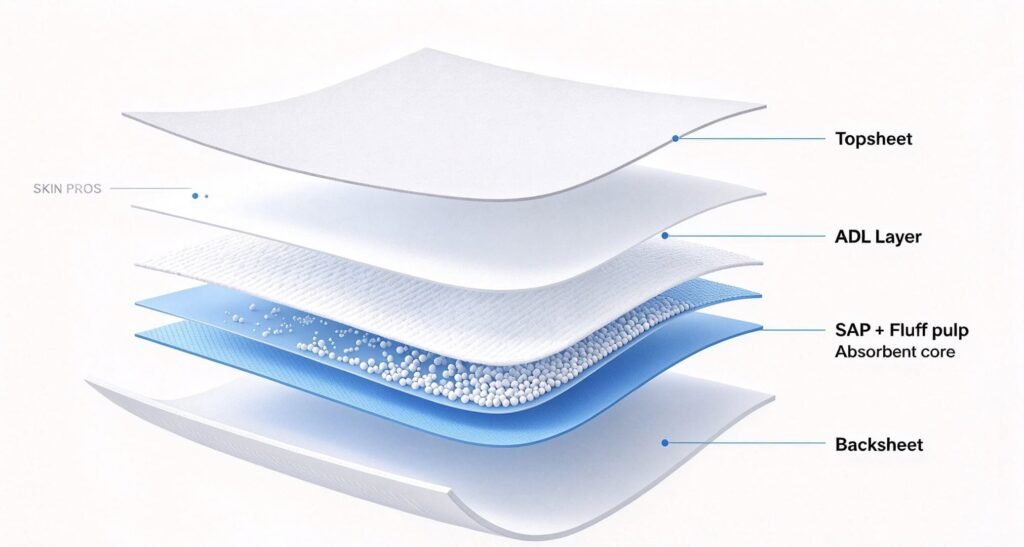
The performance of private label baby diapers depends heavily on their material structure. Two diapers may look similar from the outside but perform differently because of their internal components.
Topsheet
The topsheet is the layer that comes into contact with the baby’s skin. It should provide a soft surface while allowing liquid to pass into the absorbent core. Different nonwoven materials and surface treatments can affect softness and liquid penetration.
Acquisition Distribution Layer (ADL)
The acquisition distribution layer helps move liquid away from the topsheet and distribute it through the absorbent core. A well-designed ADL can contribute to faster liquid acquisition and more even distribution.
Super Absorbent Polymer (SAP)
SAP is a highly absorbent material used in the diaper core. It absorbs and retains liquid, helping reduce leakage and rewet. However, diaper performance depends on more than the amount of SAP alone.
Fluff Pulp
Fluff pulp helps absorb and distribute liquid within the diaper core. The combination of SAP and fluff pulp influences absorption performance, thickness and flexibility.
Backsheet
The backsheet forms the outer protective layer of the diaper. It helps prevent liquid from leaking through the bottom of the product. Breathable backsheet constructions are commonly used to improve comfort.
Elastic Components
Leg elastics, waist elastics and side panels contribute to diaper fit and leakage protection. Poor elastic design can affect comfort and performance even when the absorbent core is adequate.
6. How to Customize Private Label Baby Diapers
One of the main advantages of private label baby diapers is the ability to develop products for specific markets. However, not every component can be customized without additional cost or production requirements.
Diaper Backsheet Printing
Manufacturers may offer customized backsheet designs. These can include:
- Brand logos
- Animal illustrations
- Decorative patterns
- Size identification
- Brand colors
Customized printing may require printing cylinders, artwork preparation or minimum material purchase quantities.
Absorbent Core
Buyers can discuss different absorbent core structures based on target performance and price. For example, a premium product may require a different core design from an economy diaper.
Topsheet Material
Different topsheet materials can be selected according to softness, appearance and cost requirements.
Waistband and Elastic Design
Depending on the production equipment and available product designs, manufacturers may offer different elastic configurations.
Packaging
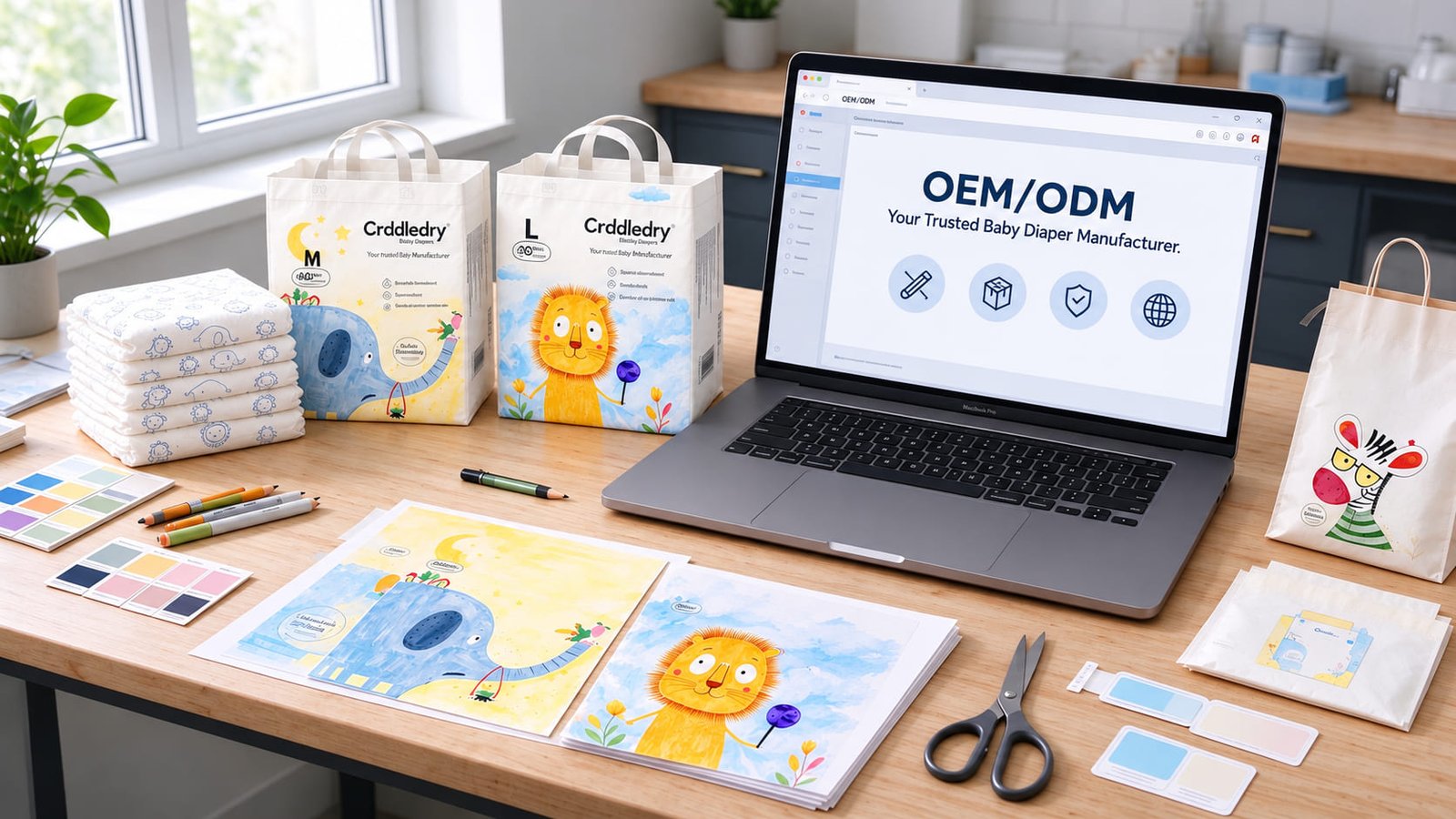
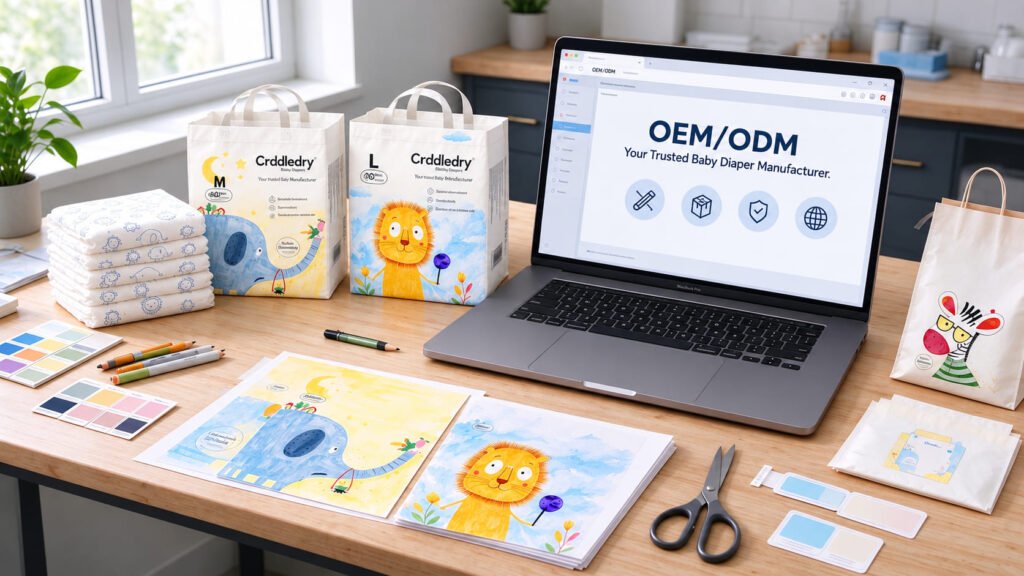
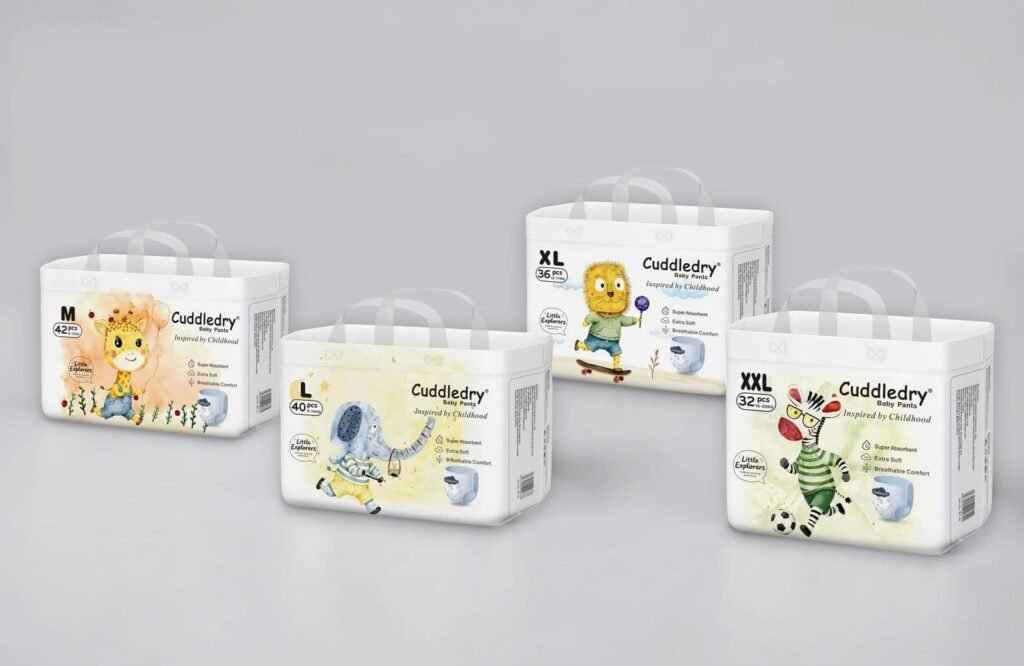
Packaging is one of the most visible customization elements. Private label customers can usually develop packaging artwork under their own brands, subject to printing and MOQ requirements. It is important to confirm which customization options are available before finalizing product specifications.
7. How to Design Private Label Baby Diaper Packaging
Packaging plays a major role in consumer purchasing decisions. For many shoppers, the package is the first interaction they have with a new diaper brand. A successful packaging design should balance visual appeal, product information and commercial practicality.
Brand Identity
Use a consistent logo, color palette and visual style. The packaging should reflect whether the product is positioned as economy, mid-range or premium.
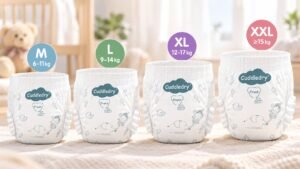
Size Identification
Different diaper sizes should be easy to distinguish. Many brands use different colors or visual elements for each size.
Product Information
Depending on the target market, packaging may need to display:
- Brand name
- Product type
- Diaper size
- Recommended weight range
- Pieces per pack
- Manufacturer or importer details
- Country of origin
- Usage instructions
- Required warnings or regulatory information
Packaging Material
Common packaging materials include printed plastic films and other flexible packaging structures. The selected material should provide suitable protection during transportation, storage and retail handling.
Packaging Dimensions
Packaging dimensions can significantly influence container loading. A package that is unnecessarily large may increase shipping costs per diaper. Therefore, packaging should be developed together with the manufacturer and logistics team.
8. What Is the MOQ for Private Label Baby Diapers?
MOQ stands for Minimum Order Quantity. It refers to the minimum quantity a manufacturer is willing to produce under a particular specification or packaging arrangement. There is no universal MOQ for private label baby diapers. MOQ can vary depending on:
- Manufacturer
- Production equipment
- Diaper size
- Product specification
- Packaging material
- Printed backsheet requirements
- Number of SKUs
- Raw-material purchasing requirements
For example, an order involving one diaper size and standard materials may be easier to arrange than an order involving six sizes, customized printing and multiple packaging designs. Importers should confirm whether the MOQ applies to:
- Each diaper size
- Each packaging design
- Each product specification
- The total order
These distinctions are important. A manufacturer may accept a total order quantity but still require minimum quantities for individual sizes or printed packaging. Before investing in packaging artwork, confirm the manufacturer’s actual production requirements.
9. How Much Do Private Label Baby Diapers Cost?
The manufacturing cost of private label baby diapers depends on several factors.
Raw Materials
SAP, fluff pulp, nonwoven materials, elastic components and packaging materials contribute to the overall production cost.
Product Specification
A premium diaper may require different materials or construction from an economy product.
Diaper Size
Larger diaper sizes generally require more materials, although the actual cost difference depends on the design.
Packaging
Custom printing, packaging materials and pack quantities affect unit cost.
Order Quantity
Order volume can influence manufacturing efficiency and purchasing costs.
Exchange Rates and Raw-Material Prices
Currency fluctuations and changes in raw-material prices may affect quotations over time.
Logistics
Freight, import duties, customs clearance and local distribution costs must also be considered. When comparing quotations, importers should make sure they are evaluating products with equivalent specifications. A lower unit price does not necessarily represent better value if the product structure, quality or packaging differs significantly.
10. How to Evaluate a Private Label Diaper Manufacturer
Choosing the right manufacturing partner is one of the most important decisions in a private label project. Importers should evaluate more than the supplier’s quotation. Important factors include:
Manufacturing experience: Does the supplier have experience producing baby diapers for different markets?
Production equipment: Can the production lines manufacture the required diaper types and specifications?
Quality control: Does the manufacturer have procedures for inspecting materials and finished products?
OEM capability: Can the factory support customized specifications, printing and packaging?
Export experience: Does the supplier understand international shipping and documentation requirements?
Communication: Can the team clearly explain technical specifications, MOQ and production schedules?
Production capacity: Can the manufacturer support repeat orders as the brand grows?
After-sales support: How does the supplier handle product feedback and quality concerns?
If you are comparing suppliers, our guide on choosing a reliable baby diaper manufacturer in China explains the main factors to evaluate before placing a bulk order.
11. Request Samples Before Confirming Your Order
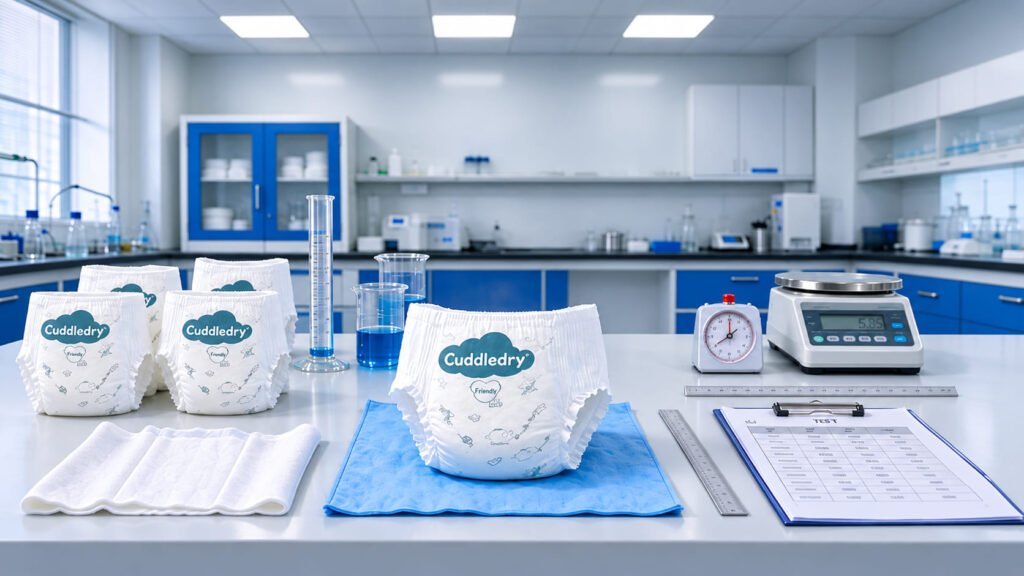
Never approve a private label baby diaper solely based on product photographs or specifications. Request samples and evaluate them carefully. Important testing areas include:
- Absorption speed
- Liquid retention
- Rewet performance
- Leakage protection
- Softness
- Elasticity
- Tape strength
- Product dimensions
- Appearance
- Manufacturing consistency
Where possible, use standardized laboratory test methods and controlled testing conditions. Actual user trials can also provide useful feedback about comfort, fit and performance. However, consumer testing should complement rather than replace appropriate laboratory evaluation.
12. Confirm Quality Control Before Mass Production
Quality control should begin before production starts. The buyer and manufacturer should agree on the final product specification and inspection requirements. Important checkpoints may include:
Incoming Material Inspection
Checking the quality and consistency of raw materials before production.
In-Process Quality Control
Monitoring product dimensions, weight, construction and other relevant parameters during manufacturing.
Finished Product Inspection
Evaluating completed products for appearance, packaging and agreed performance requirements.
Pre-Shipment Inspection
Depending on the agreement, buyers may arrange inspections before shipment. It is also advisable to retain approved reference samples.
These provide a useful benchmark if questions arise during future production.
13. Understand the Private Label Diaper Production Process
Although manufacturing arrangements vary, a typical private label baby diaper project follows several stages.
Step 1: Initial Inquiry
The buyer provides information about the target market, product type, size range and expected order quantity.
Step 2: Product Recommendation
The manufacturer recommends suitable specifications based on the buyer’s positioning and budget.
Step 3: Sample Evaluation
The buyer receives samples and evaluates product performance.
Step 4: Specification Confirmation
Both parties confirm the final diaper structure, sizes, materials and performance requirements.
Step 5: Packaging Development
The packaging artwork and printing specifications are prepared and approved.
Step 6: Quotation and Order Confirmation
The manufacturer provides a quotation based on the confirmed specifications and order quantity.
Step 7: Pre-Production Approval
Final samples and packaging details are approved before production.
Step 8: Mass Production
The manufacturer produces the diapers according to the agreed requirements.
Step 9: Quality Inspection
Finished products are inspected according to the agreed quality-control procedures.
Step 10: Shipment
The goods are packed, loaded and shipped according to the agreed trade terms. The overall timeline depends on product customization, packaging development, material availability and production scheduling.
14. How to Import Private Label Baby Diapers from China
China is an established manufacturing location for baby diapers and other disposable hygiene products. For international importers, successful sourcing requires coordination between product development, production and logistics. Before importing, confirm:
- Product specifications
- Packaging requirements
- Order quantity
- Trade terms
- Shipping destination
- Container loading
- Import documentation
- Applicable duties and taxes
- Local regulatory requirements
Understanding FOB and CIF
Two commonly used international trade terms are FOB and CIF. Under FOB, the seller’s delivery and cost responsibilities are defined around shipment on board the vessel at the named port. Under CIF, the seller additionally arranges and pays for specified freight and insurance to the named destination port, although risk transfers earlier under the Incoterms® rules.
Importers should understand the exact responsibilities under their agreed trade terms. For official guidance, refer to the International Chamber of Commerce’s Incoterms® resources. Before shipment, consult your customs broker or relevant authorities regarding the import requirements in your destination country.
15. Common Mistakes to Avoid When Ordering Private Label Diapers
First-time importers often encounter avoidable problems during product development.
Choosing Products Based Only on Price
The cheapest product may not provide the quality or performance expected by your target customers.
Developing Too Many SKUs
Launching too many sizes and packaging variations can increase inventory and MOQ requirements.
Ignoring Packaging Dimensions
Oversized packaging can reduce container-loading efficiency.
Approving Products Without Testing
Sample testing is essential before confirming mass production.
Failing to Confirm Printing Requirements
Customized printing may require additional preparation costs or minimum material quantities.
Ignoring Import Regulations
Import requirements should be checked before production.
Not Planning Repeat Orders
A successful brand requires consistent product quality and reliable replenishment. Avoiding these mistakes can help reduce unnecessary costs and delays.
16. How to Build a Successful Private Label Baby Diaper Brand
Manufacturing is only one part of the business. A successful private label brand also needs a clear market strategy. Start by understanding your customers and competitors. Choose a product specification that matches your target price and positioning. Develop recognizable packaging. Establish reliable distribution channels. Collect customer feedback. Monitor product performance and repeat purchase behavior. As your business grows, consider expanding your product range based on actual demand.
If you are still in the early planning stage, read our guide on how to start your own baby diaper brand for an overview of the product development and launch process.
17. Why Work with Cuddledry for Private Label Baby Diapers?
Cuddledry is a baby care brand supported by hygiene product manufacturing experience in China. We understand that importers and distributors need more than a standard product catalogue. Different markets require different product specifications, packaging formats and pricing strategies.
For businesses interested in private label baby diapers, we can discuss solutions based on:
- Target market
- Product positioning
- Baby tape diapers
- Baby diaper pants
- Absorbent core options
- Topsheet and backsheet materials
- Customized packaging
- Size ranges
- Pack quantities
- Container-loading requirements
- Sample development
Our goal is to help customers identify practical product solutions that balance quality, performance and commercial requirements.
Start Your Private Label Baby Diaper Project
Are you planning to launch your own baby diaper brand? Whether you are an experienced importer or entering the diaper market for the first time, selecting the right product and manufacturing partner is essential. Cuddledry can help you explore suitable baby diaper specifications, packaging options and OEM manufacturing requirements.
To receive a quotation, please share:
- Your target country or market
- Preferred diaper type
- Required sizes
- Target price range
- Expected order quantity
- Packaging requirements
Our team can then discuss suitable product options and the next steps for sample development.
Contact Cuddledry to discuss your private label baby diaper project.
Frequently Asked Questions About Private Label Baby Diapers
What are private label baby diapers?
Private label baby diapers are manufactured by a supplier and sold under another company’s brand. The buyer can usually customize packaging and selected product specifications, depending on the manufacturer’s capabilities and MOQ.
Can I create my own baby diaper brand without owning a factory?
Yes. Many businesses work with OEM or ODM manufacturers to develop baby diapers under their own brands without investing in production equipment.
What is the MOQ for private label baby diapers?
MOQ varies by manufacturer, diaper size, product specification and packaging requirements. Buyers should confirm whether the MOQ applies per size, per packaging design or per total order.
Can I customize the diaper itself?
Depending on the manufacturer, customization may include absorbent core specifications, topsheet materials, backsheet printing, elastic components and other product features.
How long does private label diaper production take?
Production lead time depends on the order quantity, product specification, packaging requirements, material availability and factory schedule. Customized printing and new packaging development may require additional preparation time.
How do I check private label diaper quality?
Request samples, evaluate product performance and confirm the manufacturer’s quality-control procedures. Laboratory testing, user trials and pre-shipment inspections may also be appropriate.
Are private label diapers cheaper than international brands?
Not necessarily. Manufacturing cost depends on materials, specifications, order quantity and packaging. Retail pricing also depends on logistics, distribution, marketing and other commercial factors.
Can I import private label baby diapers from China?
Yes, subject to the import rules of your destination country. Confirm product documentation, labeling, applicable testing requirements, duties and customs procedures before shipment.