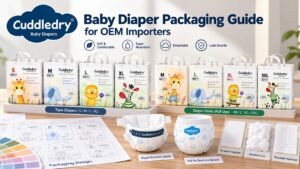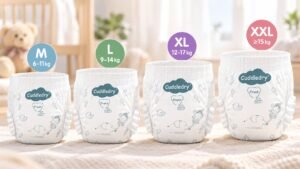
Understanding baby diaper materials is essential for importers, distributors and private label brand owners who want to source reliable products from manufacturers.
Two baby diapers may look almost identical on the outside, yet their performance, comfort and manufacturing costs can be very different. These differences often come from the materials used inside the diaper and how those materials work together.
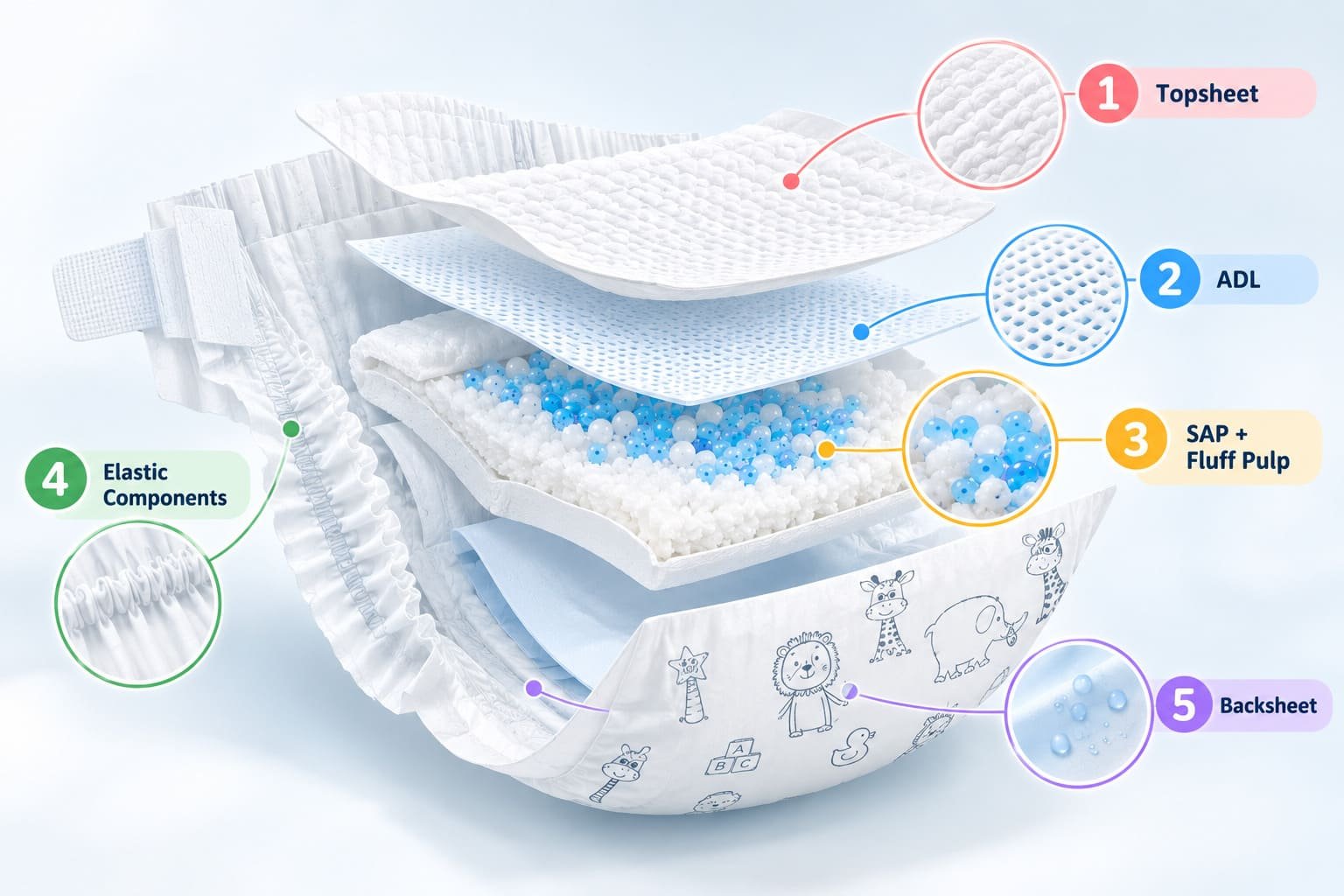
From super absorbent polymer (SAP) and fluff pulp to the topsheet, acquisition distribution layer (ADL) and breathable backsheet, every component plays an important role in diaper performance.
For OEM and private label buyers, understanding these materials can help you compare quotations, evaluate product samples and select specifications that match your target market.
In this guide, we explain the main baby diaper components, how they affect product quality and what importers should consider before placing a bulk order.
Table of Contents
- What Are Baby Diapers Made Of?
- Topsheet: Softness and Skin Contact
- Acquisition Distribution Layer (ADL)
- Super Absorbent Polymer (SAP)
- Fluff Pulp and Liquid Distribution
- Absorbent Core Structures
- Backsheet and Breathability
- Elastic Components and Leakage Protection
- Fastening Systems and Wetness Indicators
- How Materials Affect Diaper Costs
- How to Evaluate Diaper Quality
- Choosing Materials for Different Markets
- OEM Baby Diaper Material Customization
- Common Material Selection Mistakes
- How Cuddledry Supports Importers
- Frequently Asked Questions
1. What Are Baby Diapers Made Of?
Modern disposable baby diapers are engineered products made from several layers and functional components.
Each layer performs a different task, from allowing liquid to enter the diaper to retaining moisture and preventing leakage.
The main baby diaper materials typically include:
- Topsheet: A soft, liquid-permeable layer that contacts the baby’s skin.
- Acquisition Distribution Layer (ADL): Helps receive and distribute liquid.
- Super Absorbent Polymer (SAP): Absorbs and retains liquid within the core.
- Fluff Pulp: Helps transport and distribute liquid in traditional absorbent cores.
- Core Wrap: Helps maintain the integrity of the absorbent structure.
- Backsheet: Provides a barrier against liquid leakage.
- Elastic Components: Help the diaper fit around the waist and legs.
- Fastening Components: Secure tape diapers or support the fit of diaper pants.
Not every diaper uses exactly the same construction. Some designs combine functions within fewer layers, while others incorporate additional components.
The overall performance depends on how the materials are selected, combined and processed during manufacturing.
For a technical overview of common diaper components, importers can refer to the EDANA baby diaper composition guide.
2. Topsheet: Why Softness and Liquid Penetration Matter
The topsheet is the upper layer of the diaper that comes into direct contact with the baby’s skin.
It has two important functions: providing a comfortable surface and allowing liquid to pass into the absorbent structure.
Common Topsheet Materials
Baby diaper topsheets commonly use nonwoven materials made from polypropylene (PP), polyethylene (PE), polyester or combinations of suitable fibers.
Different manufacturing processes and surface structures can influence softness, appearance and liquid handling.
Softness Is Important
A soft topsheet can improve the overall wearing experience, particularly when the diaper moves against the skin.
However, softness alone does not determine product quality.
Liquid Penetration
The topsheet must allow liquid to pass into the layers underneath.
If liquid remains on the surface for too long, the diaper may feel wet even when the absorbent core has sufficient capacity.
What Importers Should Check
- Surface softness
- Liquid penetration speed
- Rewet performance
- Surface consistency
- Material suitability for skin contact
When comparing samples, importers should evaluate both softness and functional performance rather than choosing a topsheet based only on appearance.
3. Acquisition Distribution Layer (ADL): Improving Liquid Management
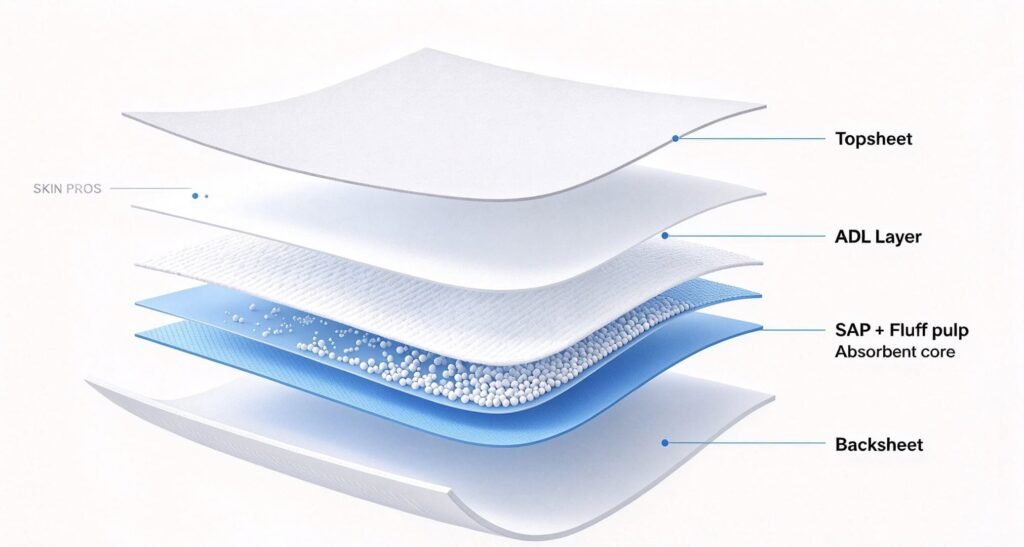
The Acquisition Distribution Layer (ADL) is an important component in many modern baby diapers.
It is generally positioned between the topsheet and the absorbent core.
Its primary function is to receive liquid and help distribute it across the absorbent structure.
Why Is ADL Important?
When liquid enters a diaper, it needs to move away from the surface and reach the absorbent core efficiently.
Without effective liquid distribution, moisture may concentrate in one area while other parts of the core remain underused.
A properly designed ADL can support:
- Faster liquid acquisition
- More even liquid distribution
- Better utilization of the absorbent core
- Reduced localized saturation
- Improved overall liquid management
Does Every Diaper Need a Separate ADL?
Not necessarily.
Some absorbent core structures and material combinations can perform liquid distribution functions without a separate, easily identifiable ADL.
The need for an ADL depends on the overall diaper design and performance requirements.
For OEM buyers, it is more useful to evaluate the complete diaper’s liquid acquisition and rewet performance than to judge quality solely by the presence of one particular layer.
4. Super Absorbent Polymer (SAP): The Key to Liquid Retention
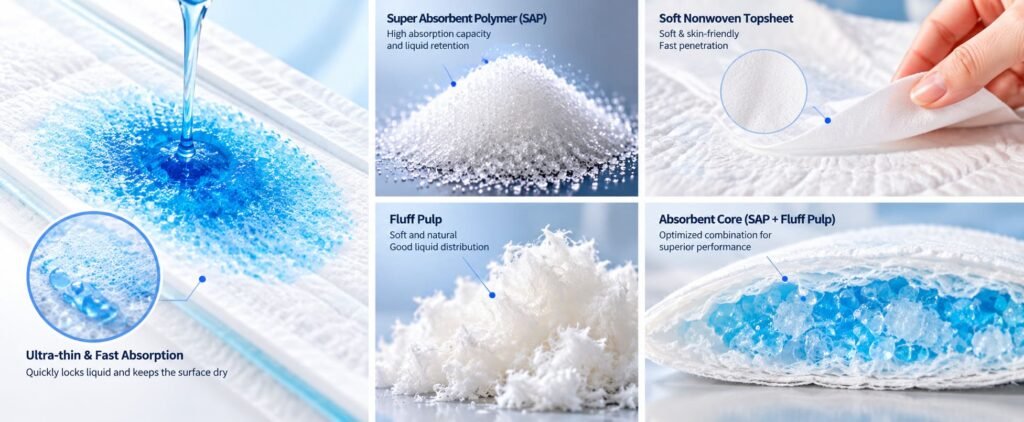
Super Absorbent Polymer (SAP) is one of the most important materials used in modern disposable diapers.
SAP is designed to absorb and retain substantial amounts of aqueous liquid relative to its own weight.
In many baby diapers, SAP is distributed within the absorbent core.
How Does SAP Work?
When SAP comes into contact with liquid, it swells and forms a gel-like structure.
This helps retain moisture within the absorbent core.
However, SAP performance varies depending on the material grade, testing conditions and the surrounding core structure.
Does More SAP Mean a Better Diaper?
Not necessarily.
This is a common misunderstanding among diaper importers.
Increasing SAP content may improve certain absorption characteristics, but overall diaper performance depends on several factors:
- SAP absorption properties
- Liquid acquisition speed
- Distribution within the core
- Core structure and integrity
- Absorption under pressure
- Rewet performance
- Diaper fit and leakage protection
Excessive or poorly distributed SAP may create challenges in liquid transport and core performance.
What Should Importers Ask About SAP?
Instead of asking only how many grams of SAP are used, buyers should request information about the finished diaper’s performance.
Useful questions include:
- What absorbent core structure is used?
- What absorption and retention tests are performed?
- How is rewet performance evaluated?
- How consistent are results between production batches?
The best specification is not necessarily the one with the highest SAP content, but the one that delivers suitable performance for the intended product and market.
5. Fluff Pulp: Supporting Absorption and Liquid Distribution
Fluff pulp is a cellulose-based material commonly used in traditional diaper absorbent cores.
It consists of specially processed fibers that help receive and distribute liquid.
The Function of Fluff Pulp
Fluff pulp provides a fibrous structure through which liquid can move.
When combined with SAP, it can help distribute moisture before the SAP absorbs and retains it.
Fluff Pulp and SAP Work Together
In many conventional diaper designs, fluff pulp and SAP perform complementary functions.
Fluff pulp contributes to liquid transport, while SAP provides substantial liquid retention.
The balance between these materials influences diaper thickness, flexibility and performance.
Does More Fluff Pulp Mean Better Quality?
Not automatically.
More fluff pulp may increase bulk and change liquid distribution characteristics, but the ideal amount depends on the absorbent core design.
Importers should compare finished-product performance rather than assuming that a heavier diaper is always better.
6. Understanding Different Baby Diaper Absorbent Core Structures
The absorbent core is the central liquid-storage system of a disposable diaper.
Different core designs can produce different combinations of thickness, flexibility, absorption speed and retention.
Traditional Fluff Pulp and SAP Core
A conventional absorbent core generally combines fluff pulp with SAP.
The pulp helps distribute liquid, while SAP provides retention capacity.
Performance depends on material quality, proportions and core construction.
Thin Composite Absorbent Core
Some modern diapers use engineered composite absorbent structures designed to reduce bulk while maintaining suitable liquid-handling performance.
These structures may use combinations of SAP, nonwoven layers, tissue and other functional materials.
Different manufacturers use different core technologies, so specifications should be evaluated individually.
Which Core Is Better?
There is no single absorbent core structure that is best for every market.
A suitable design depends on:
- Target selling price
- Required absorption performance
- Desired diaper thickness
- Product flexibility
- Consumer preferences
- Manufacturing requirements
For importers, the most useful approach is to compare samples under consistent testing conditions.
7. Backsheet: Leakage Protection and Breathability
The backsheet is the outer protective layer of a disposable baby diaper.
Its primary function is to prevent liquid from passing through the bottom of the diaper.
Common Backsheet Materials
Many disposable diapers use polyethylene-based films or laminated structures combining a film with a soft nonwoven outer layer.
These constructions can provide different surface textures and functional properties.
What Is a Breathable Backsheet?
A breathable backsheet is designed to allow some water vapor transmission while maintaining an effective barrier against liquid leakage.
Breathability depends on the film structure and material properties.
Importers should not assume that every cloth-like backsheet is breathable to the same degree.
Why Does Backsheet Quality Matter?
A suitable backsheet contributes to:
- Liquid leakage protection
- Comfortable outer texture
- Product flexibility
- Durability during use
- Overall diaper appearance
Backsheet selection should be considered together with the absorbent core and the product’s intended positioning.
8. Elastic Components and Leakage Protection
Absorbent materials are important, but they cannot prevent every leak on their own.
Diaper fit also plays a major role in product performance.
Elastic components help the diaper fit around the baby’s waist and legs.
Leg Elastics
Leg elastics help maintain contact around the thighs as the baby moves.
Leakage Barrier Cuffs
Many diapers include raised inner barriers designed to help contain liquid and other waste.
Waist Elastics
Waist elastic components contribute to fit and comfort.
The exact construction differs between tape diapers and diaper pants.
Why Elastic Design Matters
Insufficient elastic performance may contribute to gaps and leakage.
Excessive tightness may reduce comfort.
Manufacturers must balance fit, flexibility and containment.
For importers, leakage testing should include evaluation of diaper fit rather than focusing exclusively on absorbent capacity.
9. Fastening Systems, Adhesives and Wetness Indicators
Several additional components influence the usability and performance of disposable baby diapers.
Fastening Tapes
Baby tape diapers typically use fastening systems that allow caregivers to adjust the fit.
The fastening components should provide suitable holding performance during normal use.
Diaper Pants Waistband
Baby diaper pants use elastic waist structures designed for pull-up application.
The waistband should balance stretch, recovery and comfort.
Construction Adhesives
Specialized adhesives are used to bond different diaper materials and components during manufacturing.
Adhesive selection and application influence product integrity and production consistency.
Wetness Indicators
Some baby diapers include a wetness indicator that changes appearance when exposed to moisture.
This feature can help caregivers identify when the diaper may need changing.
Wetness indicators are optional features and do not directly measure the diaper’s remaining absorption capacity.
10. How Baby Diaper Materials Affect Manufacturing Costs
One reason baby diaper quotations vary between suppliers is the difference in material specifications.
Material selection affects both production costs and finished-product performance.
SAP and Absorbent Core Materials
Different absorbent core designs and material grades may have different costs.
Topsheet Materials
Premium nonwoven materials or specialized surface structures may increase material costs.
Backsheet Construction
Different film and nonwoven laminate constructions can influence cost and product positioning.
Elastic Components
Elastic materials and waistband designs contribute to overall manufacturing costs.
Packaging
Packaging film, printing requirements and pack quantities also affect the final quotation.
When comparing suppliers, importers should request quotations based on equivalent product specifications.
A cheaper diaper is not necessarily a better-value diaper.
Product quality, customer satisfaction and repeat purchases are important commercial considerations.
11. How to Evaluate Baby Diaper Material Quality
Understanding baby diaper materials is useful, but buyers should also evaluate how those materials perform in the finished product.
Importers should request samples before confirming bulk orders.
Absorption Speed
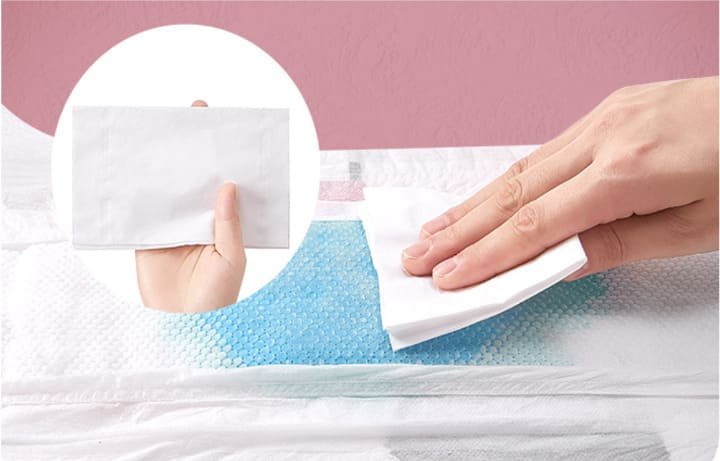
Evaluate how quickly liquid passes through the topsheet and enters the absorbent structure.
Rewet Performance
Rewet testing helps assess how much moisture returns toward the surface under defined conditions.
Liquid Retention
Retention testing evaluates the diaper’s ability to hold liquid under specified test conditions.
Softness and Comfort
Evaluate the feel of skin-contact materials and the flexibility of the diaper.
Fit and Leakage Protection
Check the fastening system, elastic components and leakage barriers.
Manufacturing Consistency
Compare multiple samples to identify variations in dimensions, weight, appearance and construction.
Where appropriate, request documented test methods and results.
Testing should be performed under consistent conditions because different procedures can produce different results.
12. Choosing Baby Diaper Materials for Different Markets
Different markets may have different consumer preferences and pricing expectations.
Importers should consider the intended market before finalizing product specifications.
Economy Market
Economy-positioned products generally prioritize essential performance and affordability.
However, low cost should not come at the expense of basic product quality and suitability.
Mid-Range Market
Mid-range products often aim to balance comfort, absorption performance and competitive pricing.
Premium Market
Premium products may emphasize softness, thinness, flexibility and carefully selected materials.
These features should be supported by appropriate product testing and clear specifications.
Local Consumer Preferences
Preferences can vary by country, retail channel and customer group.
Before selecting a product, importers should research:
- Popular diaper sizes
- Common retail pack quantities
- Expected selling prices
- Preferred diaper thickness
- Consumer expectations for softness
- Demand for tape diapers and diaper pants
The most suitable diaper is one that matches both consumer expectations and the distributor’s business model.
13. Can Baby Diaper Materials Be Customized for OEM Orders?
Many importers want to develop their own baby diaper brands using customized materials and specifications.
Depending on the manufacturer’s capabilities, OEM customization may include:
- Topsheet selection
- Absorbent core structure
- SAP and fluff pulp specifications
- Backsheet materials
- Backsheet printing
- Elastic components
- Fastening systems
- Wetness indicators
- Packaging design
However, not every customization option is available for every order quantity.
Some materials require minimum purchasing quantities, while certain product structures depend on the manufacturer’s production equipment.
Before developing a customized product, buyers should confirm the technical feasibility and minimum order requirements.
Our guide to private label baby diapers explains the OEM development process in more detail.
14. Common Mistakes When Comparing Baby Diaper Materials
Importers sometimes make purchasing decisions based on individual material specifications without considering the complete product.
Mistake 1: Assuming More SAP Always Means Better Absorption
Overall performance depends on the complete absorbent system, not simply SAP quantity.
Mistake 2: Choosing the Heaviest Diaper
Higher product weight does not automatically indicate better performance.
Mistake 3: Ignoring Rewet Performance
A diaper may have substantial absorption capacity but still feel wet if liquid management is poor.
Mistake 4: Focusing Only on Softness
Softness is important, but the diaper must also provide suitable absorption, fit and leakage protection.
Mistake 5: Comparing Quotations Without Matching Specifications
Different materials and product structures can create substantial differences in manufacturing cost.
Mistake 6: Skipping Sample Testing
Samples should be evaluated before confirming large production orders.
Importers should also choose suppliers with suitable manufacturing experience and quality-control procedures.
For additional sourcing guidance, read our article on selecting a reliable baby diaper manufacturer in China.
15. How Cuddledry Supports Baby Diaper Importers and Brand Owners
At Cuddledry, we understand that product quality begins with suitable material selection and consistent manufacturing.
For importers, wholesalers and distributors, choosing the right diaper specification is essential for building customer satisfaction and long-term business relationships.
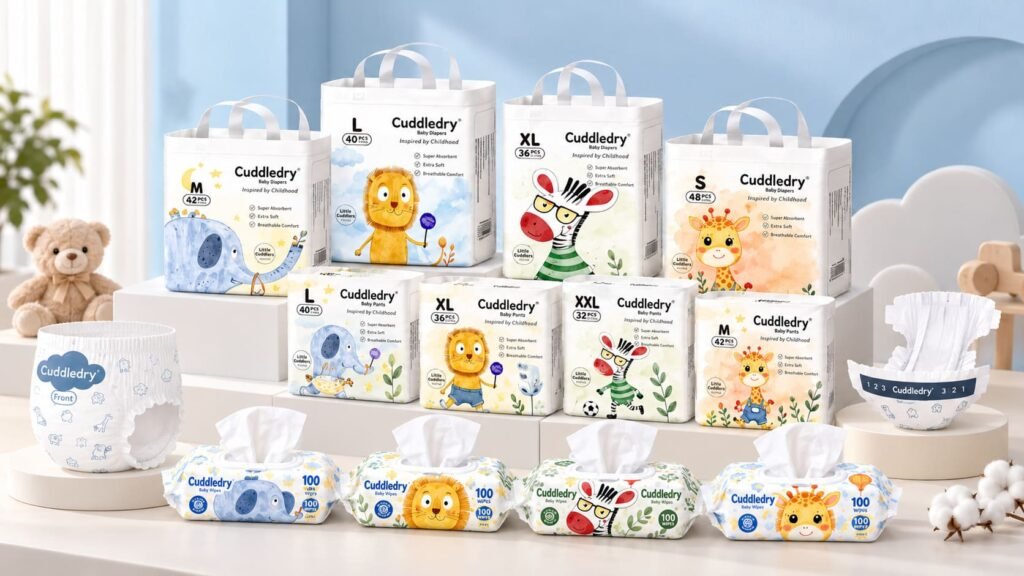
Whether you are interested in Cuddledry branded products or exploring private label manufacturing, our team can discuss your target market and product requirements.
Depending on the project, discussions may include:
- Baby tape diapers and diaper pants
- Product positioning
- Absorbent core options
- Topsheet and backsheet materials
- Size ranges
- Packaging requirements
- Sample evaluation
- MOQ and order planning
Our goal is to help customers identify suitable product solutions based on their commercial and technical requirements.
Frequently Asked Questions About Baby Diaper Materials
What are the main materials used in baby diapers?
Common baby diaper materials include nonwoven topsheets, absorbent core materials such as SAP and fluff pulp, backsheet films, elastic components, adhesives and fastening systems.
What is SAP in baby diapers?
SAP stands for Super Absorbent Polymer. It is used in the absorbent core to absorb and retain liquid.
Is more SAP always better?
No. Diaper performance depends on SAP properties, liquid distribution, core construction and other factors. A higher SAP quantity does not automatically guarantee better performance.
What is the purpose of fluff pulp?
Fluff pulp helps absorb and distribute liquid within traditional diaper absorbent cores.
What is an ADL in a baby diaper?
ADL stands for Acquisition Distribution Layer. It helps receive and distribute liquid before it enters the absorbent core.
What is a breathable diaper backsheet?
A breathable backsheet is designed to allow some water vapor transmission while maintaining an effective barrier against liquid leakage.
Are thinner diapers always better?
Not necessarily. Thinness is only one product characteristic. Absorption, retention, rewet, fit and comfort should also be evaluated.
Can I customize baby diaper materials for my own brand?
Depending on the manufacturer, certain materials and specifications may be customized. Available options depend on production equipment, material sourcing and minimum order quantities.
How should importers compare baby diaper quality?
Importers should compare products with similar specifications and evaluate absorption speed, retention, rewet, softness, fit and manufacturing consistency.
Request Baby Diaper Samples and OEM Specifications
Are you looking for a reliable baby diaper supplier or planning to develop your own private label diaper brand?
Understanding baby diaper materials is the first step toward selecting a product that matches your market.
Contact Cuddledry to discuss your product requirements, sample requests and OEM manufacturing options.